

Historical team charts 8 graves on Post 109 land
By D. Franklin
FALMOUTH — The City of Falmouth has a deep and rich history with undeniable character that charms anybody who visits it. The beautiful buildings, architecture and historical plaques located throughout the main streets tell the story of how the city was established and who the people that make up this quiet little city are.
In a time when genealogy and history have been well-documented, it is a rare occurrence for a city to uncover roots from its own past using modern-day technology. Last week, new technology unearthed part of the city’s historical roots that had been long forgotten.
At 10 a.m. Friday, Brandon Brown from American Legion Post 109, Briegh Soto from the Pendleton County Historical and Genealogical Society, and Billy Wilkerson from the Simpson County Historical Society met at Post 109, 111 Montjoy St. Their mission was to locate any residual graves that had been left behind on the property.
The grounds previously were owned by an African Methodist Church (AME) which was established between the years 1790 and 1800. The grounds next to the church, are believed to be the city’s first established cemetery.
Between the early 1800s and 1925, the City of Falmouth decided to close and relocate the cemetery. Records of the transfer are still being investigated by Briegh and the Historical Society.
But sometimes graves remain due to incomplete records, unmarked graves and the departed having no remaining next of kin to authorize the move of the grave.
During the investigation, Wilkerson and his assistant, Ashley Sutherland, walked the property using a ground penetrating radar device that uses electromagnetic waves to create an image of the soil and identify buried objects in it.
In a short amount of time, little pink flags began showing up in the grass, indicating that there were graves just a short distance beneath the feet of the people surveying the ground.
In total, the team located eight graves that had been lost with time.
The Simpson County Historical Society started this program in 2023 to begin locating unmarked graves as local historical cemeteries were being removed due to agricultural and economic growth.
Wilkerson said that during his time with the program, he has uncovered 2,793 unmarked graves, 21 mass graves, five Indian burial mounds, and two Civil War Limb Pits in surrounding counties throughout five states. Their company works solely on donations and has a YouTube and Facebook page.
Now that the team has located the eight graves, they will fine-tune the data to ensure that no others were missed.
“We have a lot of rocky terrain, so the bodies are not very deep at all,” Wilkerson said. “We have to go back and make sure that we’re not missing anything.”
It is possible that some of the rocky conditions of the soil made it difficult to place the graves at a normal depth of 6 feet. Some of the graves are noted to be as shallow as 3 feet below the grass line.
Wilkerson and Billy and Sutherland said the company is willing to come back and do additional scans of other suspected properties in the city.
As for the next steps in this story, Soto said that the Historical Society plans to reach out to the Kentucky Heritage Council and continue research to find out who these people are.
Both Soto and Brown said they are dedicating their personal time to the development of this project, and that they want to ensure that the individual graves are treated with respect and dignity.
“We’re going to try and do this right. We’re going to figure out if we can gate it (the area) off and have plaques made,” Soto said.
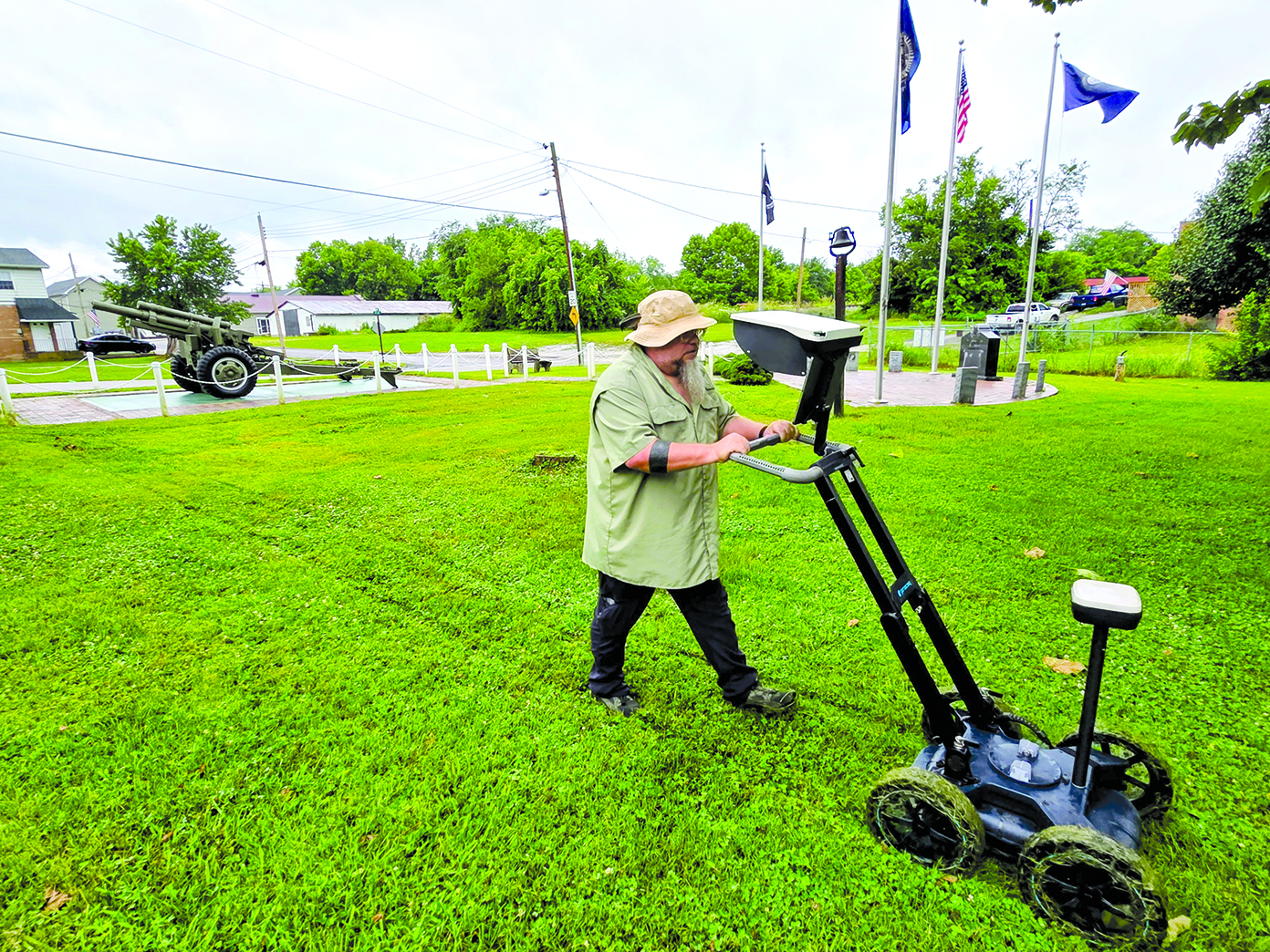
It resembles a push lawnmower, but Billy Wilkerson of the Simpson County Historical Society is using a ground-penetrating radar device last Friday at Hardin-Browning American Legion Post 109, 111 Montjoy St., Falmouth. More than 100 years ago, the site was an AME Church graveyard. The cemetery was relocated, but the device detected eight unmarked graves that were overlooked in the move. Photo by D. Franklin.
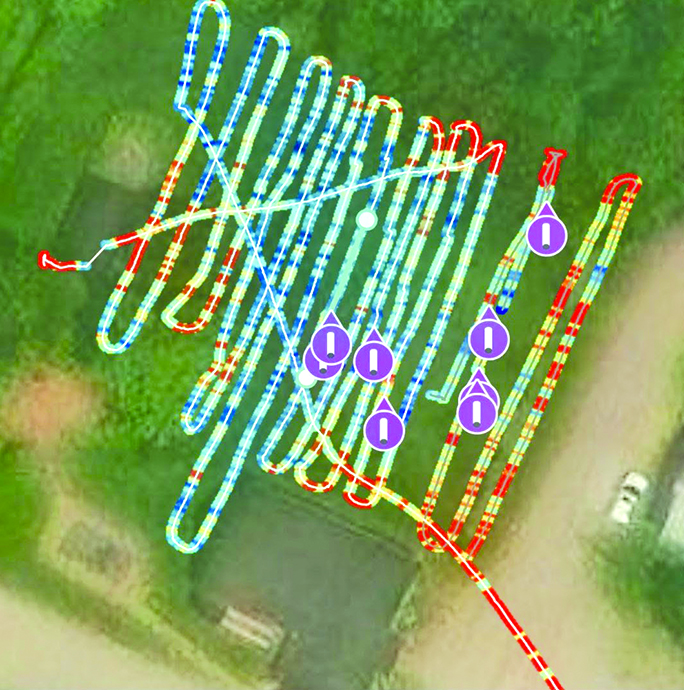
This imaging map provided by Wilkerson shows where the eight graves were detected on the post property.
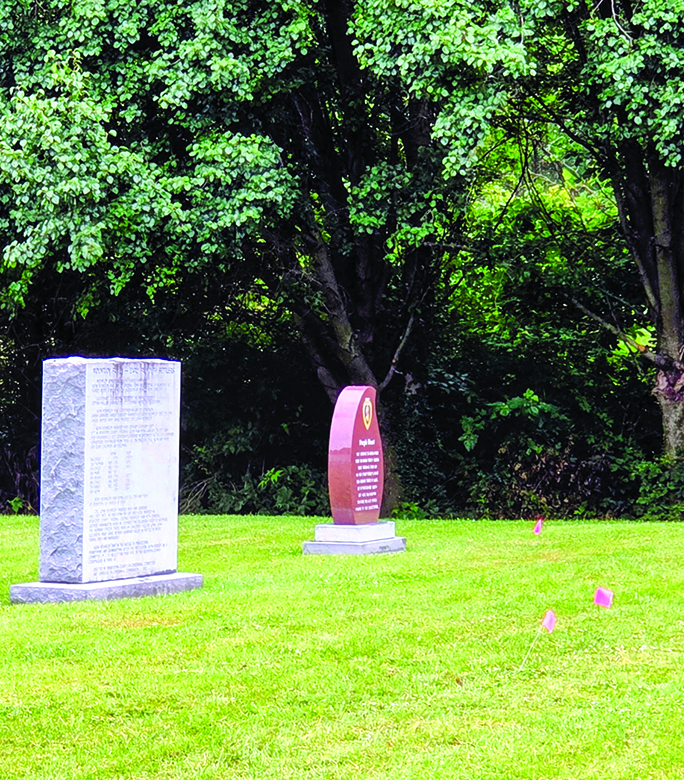
Pink flags mark where the ground-penetrating radar device detected unmarked graves at the Hardin-Browning American Legion Post 109 property in Falmouth.