
By Nila Harris
A group of innovative Pendleton Countians wanted to bring a festival to our community in the early 80s. “They wanted to put Falmouth on the map; make it a tourist thing to build up businesses,” according to one of the organizers--Jenny Boggs. The thought was to have some kind of festival in the fall. Seven people met and visited a pumpkin festival in Centerville, Ohio. “They had a giant pumpkin as big as our house,” reported Ginny Pribble. Ginny, her husband David (who was County Judge Executive at the time), Veldon and Jenny Boggs, Sally and OT Gillespie, and Karen Davis met with organizers of the event and were able to get a list of dos and don’ts. Afterwards, the group met and discussed their findings.
A committee was formed. Terry England who helped start the Heritage League of Pendleton County stated that through research, the group discovered that PC was once one of the largest counties in the state for wool production. This brought forth the idea of a sheep or wool festival.
Many people were involved in the early stages of the festival, and most wore multiple hats. As the festival grew each year, “if anyone had a talent, we signed them up,” laughed Ginny Pribble. Although the organizational duties were shared, certain people seemed to be focused on a general area. Nita Keeler, who had gone to several festivals and “could make anything," stated Boggs, organized the craft vendors, with help from Jenny. Dora Helen Fields became the food chairman and took care of the food vendors and kitchen. Leva and Andrew Kidd were brought on because of their love of mountain music and connection to the McClain Family band. Gary Barnard happened to ask if he could help with parking and that locked him in the parking overseer position for 28-30 years. “Gary was the man who came to dinner and never left, “ OT joked. Sally and OT Gillespie oversaw the promotion, advertisements, and photos. Veldon Boggs dealt with the bank and business end of things. Even though these people tended to lead the various parts of the festival, each were quick to say that it was a collaborative effort with many helping hands doing multiple tasks.
The first Kentucky Wool Festival took place on October 7-9, 1983, at the Pendleton County Fairgrounds. The hours were similar to modern day—10 am-10 pm Friday and Saturday, and 12-6pm on Sunday. Current times are the same except for 10am-6pm on Sunday. “It was perfect weather. If we had had bad weather, we probably wouldn’t have had it again," informed England.
The first year there was a buggy and carriage ride. Veldon had gone to First National Bank to get a sponsorship to make this happen. The committee wanted a way to get people downtown. The carriage would provide a tour and let people off/pick them up at scheduled stops. This was only done the first year.
There were demonstrations including a Back in Time Style Show coordinated by England and Shirley Tuemler, a sheep herding and shearing contest by Allen Miller, a textile contest with items hung and displayed, and a Through the Looking Glass fashion show. The McKenneys from Bracken County set up their sorghum making booth. Their product was so well-liked that they ran out that first year.
Entertainment was a big draw to the festival, especially the talents of the McClain Family band. The Kidds had worked with the McClains who knew and liked this area. This nationally known band was the main attraction, yet they played at the Wool Fest for free the first couple of years. Other attractions in the early years were Family Reunion String Band, Outdoor Plumbing Company, Rick Adams and Friends, and Mike Whaley as Elvis. Even the PCHS band performed at the opening ceremonies that first year, playing the National Anthem.
And of course, there was the food…The committee had decided in the beginning that there should be just one of each type of food. There was bean and corn bread, chicken and dumplings from the Church of God, Eddie Smith’s homemade barbecue, buffalo burgers sold by the Boy Scouts, chili from the Falmouth Fire Department, I. B. Back Fudge, bratwurst with peppers and onions, Howard Hoess showing the process and making lamb burgers, and Rosemary Sutton’s Home Ec. department sold burgoo.
From the beginning, the committee wanted to support local groups and provide a way to fundraise without having students go door to door. The PCHS Band took care of the parking, 4-H sold drinks, Future Farmers of America were responsible for cleaning up and collecting trash, and local churches were asked to bus tables in the food tents.
The first year an estimated 15,000 people attended the Kentucky Wool Fest. Fields would go around to each food booth three to four times a day. Each food vendor had a packet of regulations to abide by to ensure food safety. Fields would pass out gloves and see how each vendor was doing and if they needed anything. “That gave us an idea on how many we were serving,” explained Fields. The festival was never intended to be that big and soon outgrew the fairgrounds. The committee began searching for other places to host the festival.
Interesting things happened over the years. Ginny Pribble remembers the bathrooms running out of toilet paper one year and how difficult it was to get out and back quickly with the much-needed TP. She also remembers a certain demonstration with a man getting “nasty with Patti (Thomas).” The man left and Pribble had to find a replacement for the well-liked kid event. Pribble got on the phone and rounded up another who has been at the festival for the past 10-12 years.
Paul Tuemler flew Sally over the fairgrounds so that she could take photos of the parking. “He (Tuemler) was instrumental in getting the big building at the fairgrounds”, informed Sally. When the Griffins built the stage to help the fair, the Wool Fest committee was able to move all the entertainment to that stage. Jerry Fields who became the treasurer in 1995 facilitated getting an ATM machine on the grounds. Money collected at the gate was taken to a treasurer’s trailer to be counted with security provided by Ray and Jimmie Hammond. Then the money was taken to Falmouth for deposit, with Jerry being accompanied by the Hammonds. Once “when Jerry started to put the first money bag into the night deposit drawer, the bag got stuck. We had to drive to Buter BB’s to call Jim LaFollette to open the bank because everything in Falmouth was closed. LaFollette had to call his boss to open the bank with him…We arrived home at around 1:30 am and Jerry needed to be back to the grounds at 7 am to distribute the gate money and change for three locations,” Dora Helen retold.
In 1997, the Kentucky Wool Fest opened its gates at the new location on Caddo Road. People were concerned with taking it out of Falmouth, especially since the poor town had experienced such devastation from the flood that March. Ginny Pribble thought, “They will never find us," but people continued to come. Free shuttle service provided by PC schools on Saturday and Sunday helped with traffic flow, but such large crowds have continued to plague the parking situation. With an estimated 25,000 plus attending each year, the committee continues to strive to remedy this.
This well-loved, thriving event is the pride of Pendleton County. It began with virtually no money to an entity that financially supports many groups. The goal of the early committee carries through today—to support Pendleton County organizations and businesses. Missing names are the oversight of this writer and not intended to slight individuals.
Hope to see ewe all at the 2023—40th year of the Kentucky Wool Festival on October 6-8.
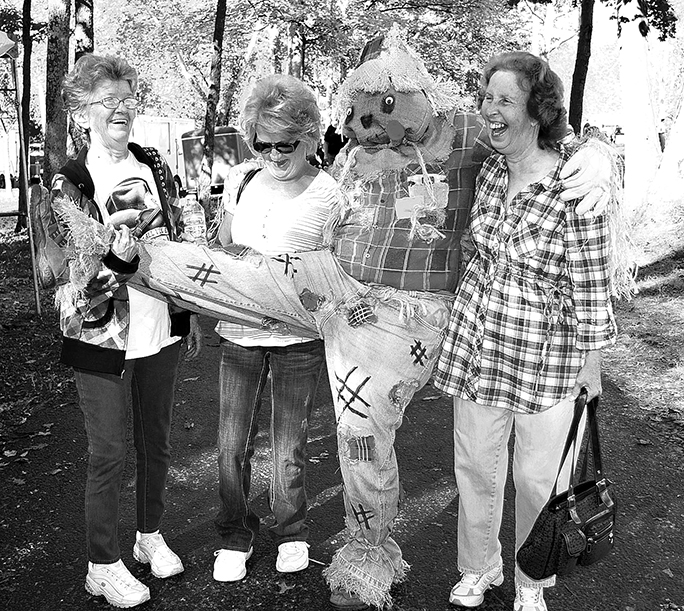
As the Wool Fest grew, so did new ideas for fun. The scarecrow was often a clown, sneaking up behind people to scare them or just finding ways to join in on the fun, as this picture from 2011 demonstrates.