

Gawkers lacking etiquette hamper dealing with rising water
Jim Thaxton, columnist
By Jim Thaxton
For those who experienced it, the devastating flood of 1997 left indelible marks on their lives. The trauma they and their community endured resurfaces when forecasts predict the possibility of flooding.
The recent five-day rain forecast triggered anxiety and memories of past hardships and challenges.
One of the most difficult challenges for victims and emergency personnel assisting are the gawkers.
Driven by curiosity, gawkers flock to the disaster zones.
Flood victims soon learn to deal with the interruptions from public curiosity as they race against a rising river moving valuables to high ground, onto trailers covered by waterproof tarps, or box trucks.
There have been more cars coming, parking and going in front of my house in Falmouth this past weekend, running the barricade, and even giving me hell for politely asking people to move so the road was open for emergency vehicles.
I wanted to strangle a gawker, especially the teenage girl who informed me that I didn’t own the “f..ing road” that she was parked on, which was causing people to cut through my yard to get around her leaving deep ruts that I will have to fill in when things dry out.
This is especially challenging for hospitality businesses like Glen Thaxton and Sara Remley, who own and operate Thaxton’s Canoe Trails and Paddlers’ Inn on the Licking River in Butler.
The couple simply stops what they’re doing, they greet the visitor with a smile and even pose for a picture with the rising river in the background.
Reacting to the human emotions of empathy and fascination and meaning no harm to those dealing with the natural disaster, gawkers want to bear witness to the destructive force of nature firsthand.
In ’97 they had digital and video cameras.
This time around their smartphones were not only able to do the job of both their ancient cousins but also send the pictures, videos and audio directly out to the entire world.
Drones are another technological innovation since the ’97 floods, adding, on the one hand, a new dimension to the invasion of privacy, and on the other hand, drones can be useful for search and rescue operations and give a bird’s eye view of the disaster event as it is happening.
These amateur journalists can be found standing shoulder to shoulder with professional media.
While the media raises awareness about the needs of the community in the affected areas, the gawkers, though sympathetic, often unintentionally interfere with aid workers, block driveways of victims homes hindering the efforts of residents trying to save their properties or assist others in the community.
Even more disconcerting are the thoughtless gawkers who ignore barriers, drive onto water saturated lawns, causing deep ruts that take months or years to repair. Or perhaps worse of all are those gawkers who become verbally abusive to victims who politely ask them to move.
Having lived through and worked several natural disasters, it has often occurred to me to create a manual on gawker etiquette.
• Gawkers should never remove or go around official barricades.
• Gawkers should not park and leave their cars on public roadways blocking access to emergency personnel.
• Gawkers should respect private property and seek permission for access.
• Gawkers should respect the privacy of victims.
And that’s just a short list of some of the things gawkers were observed doing during this recent natural disaster.
It is not all negative, as we also witnessed gawkers offering their assistance. Many plan to return to assist with recovery efforts.
Instead of investing your time and gas to visit a disaster area, send the money you saved to the Red Cross and other relief organizations.
Natural disasters test the resilience of individuals and their communities. A flood event can bring out the best and worst in human behavior.
While a manual of gawker etiquette might be a bit overkill and likely never read by gawkers who fail at commonsense and appreciation of boundaries — gawkers should practice one simple rule to prevent adding stress to the victims of natural disasters: “Do no more harm.”
Thaxton is a retired Pendleton County High School math teacher. He and his wife, Ann, owned Thaxton Canoe Trails in Butler.
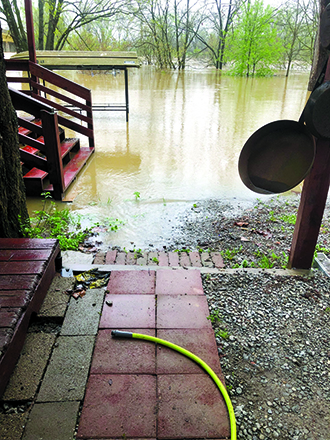
Jim Thaxton took this photo from the one looking out the office door of Thaxton’s Canoe Trails and Paddlers’ Inn in Butler. “We have a saying up there: ‘When the river reaches 44, it is at our door.’ It was right at 42 feet when the photo was taken,” he said.