

By Burton Cole
FALMOUTH — Eleven Pendleton County High School students assumed the roles of city councilmen, business leaders and activists in an economic development simulation last week that officials hope foreshadows a bright community future.
“It gives students a real-world connection to how businesses are run,” said Shannon Dalzell, the gifted and talented teacher whose students made up the mock community leaders in the Pendleton County Youth Leadership Economic Development Simulation.
“It’s kind of a reality check for me,” said student Abby Kopp, who played the role of Sarah “Jobs for Kennett” Thompson.
“I didn’t realize how much goes into something that I thought was so small.”
And that’s the point, according to Tami Vater, director of county economic and tourism development. She and other local officials want to foster a new generation of people who will get involved in government and the development of Pendleton County.
Vater said it was wonderful to see young people so engaged in the simulation and learning so much about what it takes to bring in new businesses and to make sure the opportunities fit the community and are handled correctly.
Not only was it a lesson in civics, but it also involved public speaking, critical thinking, and learning how business happens, she said.
“It was definitely a great day,” she said.
“Over the years, I’ve attended the adult version of that (development simulation).
“I started working with Shannan. I said I would like to do the high school version.”
She did the research and with local leaders developed the opportunity to introduce young adults to local government.
THE SIMULATION
The goal was to have 15 students, but only 11 decided to participate in this debut year. Vater and others said they believe that next year’s group will be larger because this first group will go back, talk about it and more interest will be piqued.
An adult mentor was assigned to each student. Volunteer mentors included not only locals such as Falmouth City Councilman Anthony Cox, Pendleton County Magistrate Joshua Plummer, county Chamber of Commerce President Gary Hicks, and Brett Price of the county planning and zoning department, but also state and regional officials such as Kentucky Cabinet for Economic Development members Malcolm Jollie and Brandon Combs, Kentucky Touchstone Energy representative Brittany Cox, Duke Energy rep Cara Brooks and Jeremy Worley of BE NKY Growth Partnership, the economic development company for Northern Kentucky.
The adults were there to coach the students on questions to ask, issues to bring up and other points to tackle.
But when the simulation began, the adults remained in the background. They whispered tips if needed, but the students took the lead.
The scenario was this: The company Plastics R Us wants to build a research and development engineering center that will house 200 skilled mechanical, electrical and plastic extrusion engineering positions.
The company has narrowed down the choices to Falmouth County, Tennessee, a thriving metropolitan area that some say is growing too quickly, and Outlying PC County, Kentucky, a micropolitan area that is small and hungry for quality development.
It has gone to both counties to see which community offers the best tax incentives, infrastructure and other support for its industry.
In the morning session, students took on the roles of the counties and business to negotiate the best offer.
Eventually, the business Plastics R Us chooses the site in Kentucky adjacent to Kennett City, and petitions to annex the county land into the city.
In the afternoon session, the students took the roles of the city council members, city planning and zoning officials, business owners and community activists.
Abby Kopp as Sara “Jobs for Kennett” Thompson pleaded for council to do everything in its power to bring in the business while Gavin Laney as John “No More Tax Breaks” Benedict railed against tax giveaways, and raised concerns about increased traffic and pollution.
In the end, Kennett City Council approved the annexation and tax incentives over the opposition.
LESSONS LEARNED
“You do have your hecklers in the crowd,” mentor David Fields, the Pendleton County judge executive, told the students.
“Not everybody is going to agree with the decisions you make. If you can get 60 to 70 percent, you’re doing great.
“We try to make the best decisions we can of the information we have,” Fields said.
Fields said the simulation gave students the gist of all the research that goes on behind the scenes — from zoning regulations to economic and environmental factors to local impact to incentives that can be secured locally and from the state — before proposals reach the council floor for a vote.
Vater told the group, “That was a very fast, abbreviated process of what happens in city council meetings.”
The average timeline, even to fast-track a new business coming in, can be six to eight months, she said.
Companies find reasons NOT to locate in your community and it’s the job of the community leaders to outweigh the negatives.
One of the complicating factors is that a lot of times, communities don’t know they were under consideration by a corporation until the business has already narrowed it down to the top two choices. Then it becomes a scramble to put together a package with all the reasons the company should choose us and not them, she said.
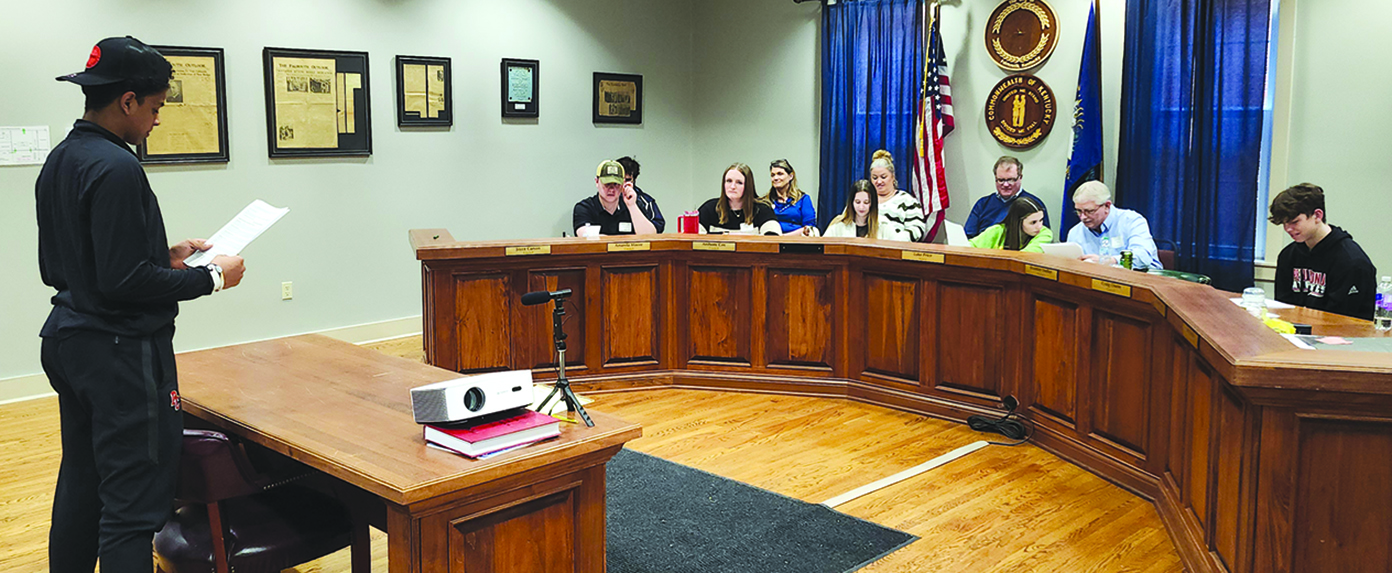
Pendleton County High School student Gavin Laney, left, portraying John “No More Tax Breaks” Benedict, states his case before “Kennett City Council” about why he opposes tax incentives to bring new business Plastics R Us into the city. The session Thursday in Falmouth City Council chambers was part of a Pendleton County Youth Leadership Economic Development Simulation that paired gifted students with mentors from Falmouth, the county and the state to develop more of an understanding of the process involved

Cassie Callahan, right, who took on the role of the Mayor of Kennett City, consults with Pendleton County Judge Executive David Fields, her mentor in the economic development simulation. Photo by Tami Vater.