

Residents overflow city hall to find out during special meeting
By Carolyn Reid
The first 2023 meeting of Falmouth City Council drew a standing-room-only crowd consisting of city residents, business owners, and a few interested county residents as the new council discussed the city police department in a one-hour long special meeting. Audience comments were welcomed during the meeting.
The purpose of the special meeting was to be for council to allow the new mayor to go to speak with Judge/Executive David Fields and the sheriff regarding the possibility of working out a plan for the county to cover the city. The questions that came up from the outset, though, led to a detailed discussion not only about those possibilities but also the problems and concerns of the citizens and others who were present. The meeting lasted an hour.
Mayor Sebastian Ernst explained at the outset of the special meeting that the city was down to one police officer for the town after the resignations of the chief, assistant chief, and other officers that started several weeks before the new administration and council were seated.
Two resignations took effect on December 31, 2022.
“This isn’t unusual,” Ernst said. “We’ve had this happen in the past. Any time there is a change of leadership...the same thing is happening in the sheriff’s department now.
“I also felt this is a good time to explore our options before we can go forward. One of those options, and I’ve been pretty vocal about this over the years, is to look into possibly contacting the sheriff’s department. I personally believe this will be a lot more beneficial to the city because it will cost us far less money to just cover the additional manpower they would need.” Later, he stated that he felt the discussion had been forbidden in the past.”
He also explained that fiscal court is willing to negotiate the terms, but Judge/Executive David Fields had made it clear he wanted it to be with the approval of council.
Councilperson Luke Price began the questioning, stating he understood the need for a long-term fix, but his focus at this time was on “safety and protection of the city in the time the council was working the issues out.” He asked Ernst what plans he had for temporary coverage, if the city would try to work out a temporary arrangement with the county in the meantime. Ernst replied that he had spoken with Judge/Executive David Fields and Sheriff Jared Brewer, and if council was agreeable, he would cover overtime and additional costs during the time.
Price then asked if the city would still have 24-hour coverage, or if that coverage would be reduced with the understanding the city does have one officer available in the interim.
Ernst replied that the sheriff’s office is still working on restaffing, so he and they would not be able to “get to the meat of those discussions” until council voted to allow him to speak with the judge.
When Councilperson Amy Hurst voiced the concern that they were trying to make decisions with no information such as salaries or estimated hours. At that point, City Clerk Ramona Williams explained the vote was only to allow Ernst to go to the judge to have the conversation.
Price agreed it was in the city’s best interest to talk a temporary arrangement, heavily emphasizing the word “temporary,”because they needed to work with the current issue as they talk out the permanent solution that is best for the city while Hurst emphasized the council did not want to lose services for the city.
When City Attorney Brandon Voelker cautioned that temporary and long-term solutions go hand-in-hand because people could not be expected to commit to a temporary employment, he then recommended council negotiate a level of service and the sheriff could tell them the cost of doing what is required.
Hurst responded she felt they needed to research and look at all the numbers, citing another instance a few years before where they had some positives and more negatives. She said it would take more than a week or month to research and truly decide if this path was best for the city. Price asked about getting an outside firm to research the topic without bias, but Voelker returned to the idea that they mostly needed to decide the level of service--man hours per day and per time of day--required.
Councilperson Sabrina Hazen focused on the fact that city residents pay county taxes for sheriff’s coverage as well as taxes for police coverage, and she felt that if the sheriff’s department covered the city, the city should receive the same coverage from the county as the county receives. Price agreed that that should be the case, but he pointed out that city officers have had to go out to the county to help cover the county “multiple times” instead due to staffing concerns at the sheriff’s office, and that has been done with no charge to the county.
Councilperson T.W. Morrison noticed that the city had spent $18,000 on police overtime, and that number was headed toward $40,000 for the year at that rate. He acknowledged that is “a lot of policing.” While Councilperson Darryl Ammerman reminded the council that the overtime included court time, Administrative Assistant to the Police Dolly Plummer said that included the shortage of officers, four instead of six, leading to overtime to cover shifts.
Price pointed out that they would be paying time-and-a-half to the deputies who cover along with gas and retirement, and Hazen once again stated that would be paid in addition to the city already pays for county services. Morrison commented, “When and if they come.”
Councilperson Joyce Carson asked if the constables would be available to patrol their districts to help with situations and alert law enforcement as the situation is worked out, and Voelker pointed out that is similar to what is being done in Alexandria.
After clarifying the police positions were posted, Ammerman stated something needed to happen “tomorrow.” At that point, motions were made and seconded for Ernst to go to the judge and fiscal court to discuss a possible temporary solution. The vote carried unanimously. Voelker then suggested possible levels of service for the council to consider so that Ernst would have direction as to how to proceed. (Voelker had also suggested recruiting retired officers and other qualified people to help police the city while council is considering the best solution.)
When the audience was invited to give input, some members shared the following questions and observations; at times, more input came from the council or the mayor.
•Butler has a chief of police and that is all. Hurst responded that Falmouth officers have to go to Butler to assist there.
•Audience members complained that of calling the police before with no response. Those complaints were missing a missing license plate and a missing bicycle. The person who complained of the license plate had called all three divisions—police, sheriff, and Kentucky State Police—with no response.
•Former mayor April DeFalco spoke. “The only thing I worry about is safety and what the citizens want because, ultimately, they pay for it. It has been discussed many, many times. We looked at multiple ways, and people just didn’t want to give up that safety and that response. It does lead to management, and how do you manage your officers. And will ABC funds (tied to liquor licensing) go to the sheriff’s department if you turn everything over, and other stuff like that. A lot of that has to be considered, but first and foremost it has to be the safety of the people and businesses.” She questioned, too, if businesses would move to the city area if police protection was not guaranteed. She also stated she had researched the topic, and the merging of city and county has worked for large departments, but she said she could not find much information on small departments. When Ernst asked her if the level of service if she would be favorable if the level of service would be matched by the sheriff’s department, she reminded him, council, and all attendees that the main function by state statute of the sheriff is tax collection. Ernst said that the sheriff is also the chief law enforcement officer in the county. While she stated some sheriff departments are not to answer calls during tax season, Voelker clarified the function of the sheriff is set the county and that it is a matter of what you want the sheriff’s office to become.
Ernst said that insurance has also been a topic of discussion, and the city can remain accredited with a chief of police. Williams said that came from the Kentucky League of Cities. Plummer pointed out the accreditation is up this year.
Price asked for clarification. “If we do go strictly with the sheriff’s department, the accreditation goes away, and Williams responded that was so, and the city would lose the discount on the insurance.
DeFalco also brought up the idea that if a newly-elected sheriff comes in, the city has no control from the moment the sheriff’s department takes over. Voelker stated, “We would do an interlocal agreement like we do with fire.” That would mean the expectations for Falmouth service would be outlined for the sheriff’s department since the city is paying for the service.
•A retired federal agent shared that no one would be willing to come to the city to serve with the pay scale. (Starting pay is $16 for an officer in Falmouth.) “Do you think I would put my life on the line for $16 when I could go flip burgers for $20?”
•Someone complained, “We never had much coverage for what we paid for,” with some approving mutterings flowing in the crowd. He stated he had never seen police lights on Chapel Street, and the night before he had seen the sheriff on Chapel Street. “For the first time in five years, I saw police lights on my street, and it was the sheriff.” Another stated she had called the Falmouth Police on a few occasions in the three years she had been in the city, and the situation has never been resolved. The call she cited was a stolen bike her husband found a few days later and brought it home. Price suggested that accountability and accessibility with the right administration to set standards, then holding the police department to the standards would be helpful in the future.
“You set a standard, and then you hold to the standard. As a city, we should be doing that.” The audience member doubted anyone would come in for the pay, but she said if they do, they agreed to that, and they should care about the residents of the city. “We don’t care how it goes. We just want to be protected.” Ernst acknowledged the department is one of the lowest-paid departments in Northern Kentucky, “and we should put our resources together to have better pay.”
•One person shared that a person was assaulted in her yard. She stated the officer did not do anything when he was called. She acknowledged the officer did not see the incident, “but we had witnesses. They didn’t do anything. It’s on video. Still didn’t do anything.” She went on to state that she was the mother who lost the son in the house fire on Chapel Street. The sheriff’s department nor the fire department could get her son out, she said. “They tried. You’re going to have emergencies where you need to have officers there. Just because it’s a small town, there is very little crime, doesn’t mean you not going to have one of those instances like we had.” Plummer said, “Two city cops showed up, and they saved your kids,” to which the mother replied, “Let’s not go there.” She did acknowledge that Officer Keene was “a wonderful officer” and helped with her daughter, but she got everyone else out. Plummer reminded her, “If they had not have been there, that would not have happened. The mother replied that was not the point. (The story published after the fire stated that Officer Keene and Officer Ruey Couch, who has stayed, were instrumental in alerting the family at their own risk.)
•“We need to get back to the place of the small-town where we know our officers and the officers know our citizens. This is HOME,” one member commented. She said she did not know the police officers who worked in town, and asked if others did.
•Assistant Fire Chief Travis Reis told the audience and council that one person he knows personally and professionally has applied for the chief’s position knowing the pay, and he has four people who want to come with him. He loves the city, and wants to try. He shared that he knows the officers, and they are open to getting to know others. Others just have to try, as well. Someone pointed to Officer Mark Branham who recently resigned and praised him for being visible in the community and for caring for the kids.
•Former Officer Mark Branham came forward to speak. “I’m one of the officers that left. It is totally absurd when I see some of these comments that people are making that we don’t care about the community. We cared about the community. I can’t speak for the other officers that responded to your bad calls. All I can talk about is me. What I want to say, first of all, is it was never about the money for me. I put in my 22 years here. I came here because I love the community and I love the people in it and I love the kiddos.” He explained he and Sheriff Quinn tried to get him on as the school resource officer for Southern, but the superintendent would not split the contract with the sheriff’s department and Falmouth. Southern is the only school in the city.d “I still go up there because I love the kids.” He plans to go there to see them even when he is in another uniform. “Two of the five who left were retired and that didn’t affect us. I’m pursuing the SRO position….You may not see the blue lights, but they’re there.
“This is how bad it is going to get, and I’ll give you an example. This morning, at 6:01, there was a domestic and it was 7:36 and a second call before they got anybody out there. (Note: an off-duty deputy was called to answer the call. He had just gotten off duty at 4 a.m.) It’s going to get bad unless you all decide something.
“My question is for you, Mayor, prior to all this, you reached out to me in a text message, and you knew three weeks in advance that all of us were resigning. Those letters were turned in. Why didn’t you reach out to any of the supervisors—the chief, regardless of your feelings about him, the assistant chief, even the sergeant. You didn’t reach out to any of them except me. I came to the conclusion you were looking into me stepping into the position after everybody leaves; I don’t know that. I wouldn’t have taken it anyway.” He explained that Falmouth will be hard-pressed to get and keep officers at the pay scale because those out of the academy will come here to use it as a stepping-stone to go on to better positions where they can get paid double. He saw that he and Officer Couch would be working 12-hour days, seven days a week, with no one else wanting to come to work in the city.
He asked again, “Why did you contact only me?” Ernst replied, “All the others had turned in their resignations,” to which Branham replied, “I had, too.” Ernst said he had heard great things about him, and he “had no intention of firing any officers.” He was to be hired for a larger position, he said. Branham reminded Ernst that he went straight to Fire Chief Dave Klaber when he resigned, but Ernst sent no texts or made no calls to anyone in the police department upon their resignations. Branham said he wanted to let everyone know for a fact that they love the community, and he even moved to the Falmouth area because he loves it so much. After an audience member assured him she knows he loves the community and he is a great person, Branham said to council, “You need to work out something quick because it’s going to get ugly.”
•A member of dispatch spoke to confirm Officer Branham’s account concerning the call that morning that had a delayed response to a domestic situation due to a lack of coverage. “If we had city police, they could respond a lot faster than a deputy out in the county.” To add to the situation, the deputy who was called in after just finishing his shift had to be awakened to go alone, which is against safety protocols in the situation. She also shared that discussion is trending toward deputies going to the AA Highway for traffic stops, and if something happens in town, those deputies cannot get to Falmouth in a timely fashion.
An audience member pointed out that the city officers have not lived in Falmouth, anyway—some coming from Edgewood—and the dispatcher stated that they are in the city during their shifts, and no one was on shift in the city or the county at that time.
•A regular council meeting audience attendee did ask why, if people were having troubles as they say, they had never been to a meeting to discuss the problems. “It’s your city! It isn’t mine. Fill this place every time.”
•Assistant Fire Chief John Lucas stated that the fire chief is held accountable by the mayor, but the city is not being held accountable for other actions. He stated that all need accountability in order to be efficient. He felt the past chief was not held accountable as he should have been, and he felt as though people did not see or understand that. “If the department head isn’t doing the job, the guys won’t do their job.” He felt from what he was hearing from the audience, the police chief was not being held accountable. He also shared that he had spoken with the officer who was interested in being chief, and he said he had four experienced officers ready to come to Falmouth.
•Another audience member asked if there were conversations council should have with any of the officers the council would have wanted to keep, and Ernst stated the city could do an exit interview with them.
After the audience comments, Williams informed the audience that the city has given three percent raises annually, and this past year that raise was five percent, and Plummer reiterated that Ernst never reached out to the officers who left.
Price pointed out that the thought of savings to the city was in error because really, if the police department was cut, taxes should be lowered for citizens because they will receive less coverage. When he asked Ernst what he planned to do with the saved funds, if there were any, Ernst stated he would use that money to bring down dilapidated properties. “It costs tens of thousands of dollars to take down.” He also stated we don’t have a budget for that type of activity. Council reminded him the money had been allocated for that purpose, and legalities hold them up from using that money to remove the house he cited as an example. “It’s not a funding issue,” Price and Hurst both said, as Ernst insisted it was. “It’s a legal issue,” Hurst said again. Ernst argued it was a funding issue because the city had multiple properties that were in need of attention, and the funds were not available to handle it all.
Hazen argued that the discussion should be what is the best option with the money that the city has to provide the most effective service. She said she did not want it to look like they are cutting services (such as the police) to have money to take care of dilapidated properties. She wanted to look at the idea that citizens were paying for a service they did not feel was up to the standard they paid for. Hurst reminded her that sometimes you hear the negatives more than the positives from public service, but she did agree constructive feedback is needed.
Ernst stated he had run numbers with officers making $20 an hour, and even at four or five officers, the city would still save money. “But we lose control as a city,” Hurst stated, acknowledging both the lack of control of guaranteed coverage for the city as well as hiring decisions. Voelker reminded the council that the mayor is the one who is in charge of the chief, but in the county setting, that would not be the case.
Ernst invited the audience to contact city hall, a councilperson, or himself if they had questions or concerns before council adjourned the special meeting.
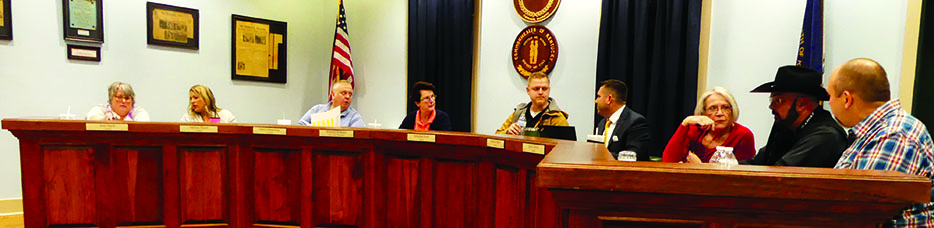
The 2023 city council settles in before their first meeting, a special meeting to discuss city law enforcement takes place. The meeting lasted an hour with council hearing from city residents and a former police officer as well as other first responders before it ended.