

Black History Month
By Jim Thaxton
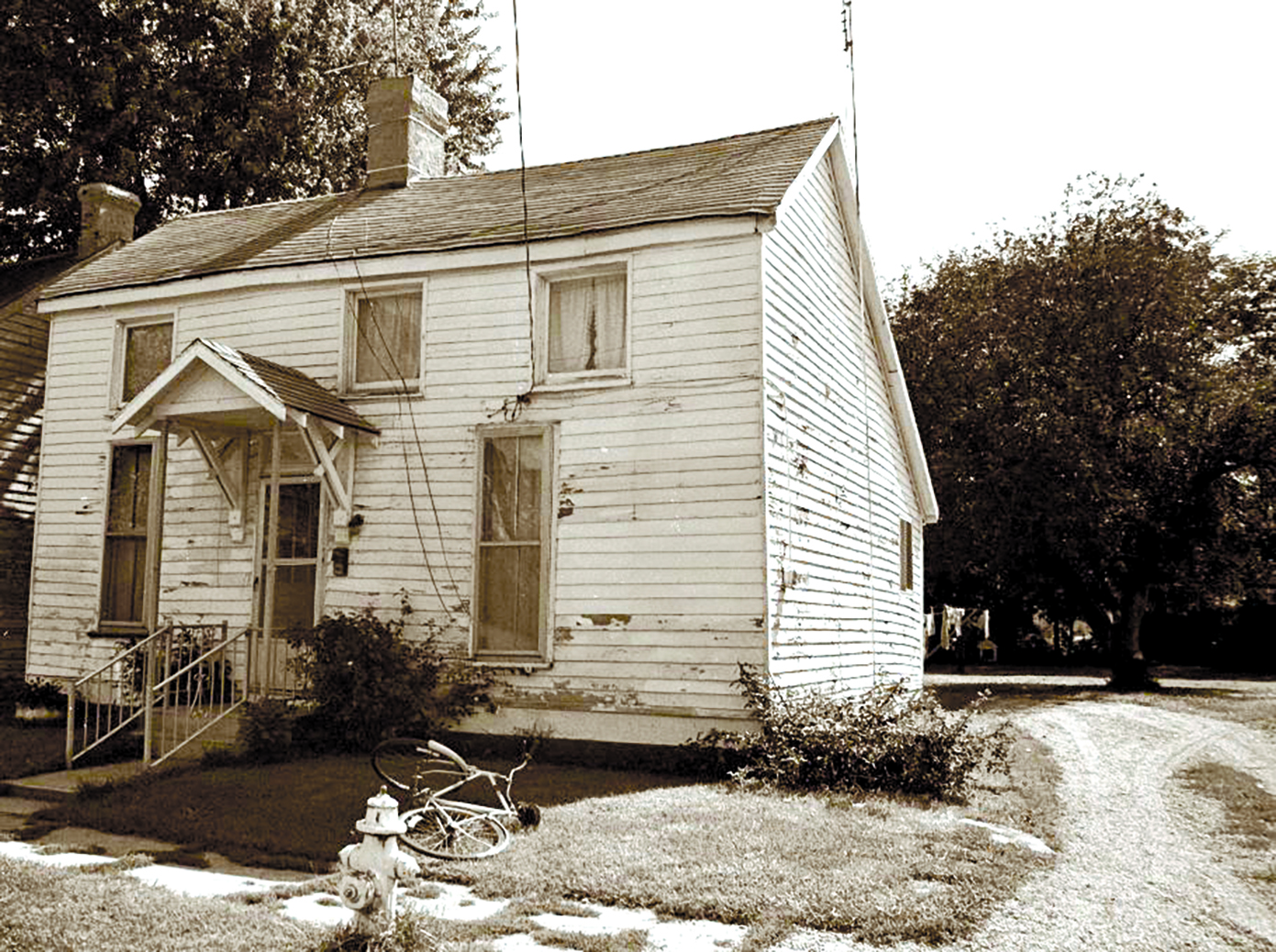
FALMOUTH — Her house and many others in the area once known as Happy Hollow are gone, casualties of time and the 1997 flood.
But now, Pendleton County residents and agencies are being asked to support an effort to secure a spot in the 2025 Kentucky Historical Society’s Historical Marker Program for the property where Charity Southgate’s home once stood.
Southgate was an African-American who was born free but sold back into slavery. After a long legal battle, she finally was granted her freedom again at age 28. She built a home at 108 Montjoy St., at the bank of the South Fork Licking River.
She would go on to build several other houses on the block for her children and grandchildren. Many of Falmouth’s African-American citizens can trace their ancestry directly back to Charity Southgate.
Among her descendants are Harry Crozier, the pastor of First Baptist Church in Falmouth, and Abram Crozier, pastor of Trinity Southern Baptist Church in Falmouth and the Falmouth Police Department chaplain.
Tami Vater, Pendleton County’s director of tourism and economic development, last week shared with the county Fiscal Court an email that she and Judge Executive David Fields received from Cheryl Crozier Robinson.
She requested support for a historical marker featuring Charity Southgate.
The 2025 Topic Nomination Packet includes an application form that must be returned by April 1 with strong evidence of community support.
“Hopefully, we can include letters from a broad cross-section of the Pendleton County community,” Crozier Robinson’s email states.
“The review committee will expect to see enthusiasm for the Charity Southgate marker expressed by representatives of the local government, civic groups or societies, community leaders and advocates, and organizations involved in historic preservation.
“Letters should be unique and written in the writer’s own words. I would appreciate your help in getting the needed letters.”
Vater said that she is helping contact local church congregations, the Retired Teachers’ Association, the Pendleton Historical Society, Pendleton County Tourism, students, the Pendleton County Seniors, local government, Pendleton County Chamber of Commerce, and individual citizens with enthusiasm for historic preservation to help make the Charity Southgate Historical Marker a reality.
To allow time for the letters to be added to the application they should be sent no later than March 17 to Gerald Robinson, 5222 Delaware Drive, Louisville 40218, or emailed to gmrobinson2002@yahoo.com , she said.
The house was listed on the National Register of Historic Places in 1983 while it still stood.
According to Crozier Robinson’s email, “Charity is an example of self-determination and perseverance. She fought in court for over two decades to prove her right to freedom, and to secure that right for herself and her children.
“She also bought her husband’s freedom. The area of Falmouth called Happy Hollow, was settled by Charity and Allen Southgate, their children and their descendants.
“Charity was born in 1806 in Loudoun County, Virginia. She was the daughter of Martha ‘Patsy’ Palmer and an enslaved house servant of Robert Foster. Foster was Patsy’s brother-in-law.
“Since Patsy Palmer was white and free, Charity was free. The laws at that time stipulated that the status of the mother determined the status of the child. This fact would propel Charity on her journey to freedom.
“The birth was treated as a family disgrace of course. So, when Charity was about 2 or 3 years old, she was given to a family friend, Asher Pullen. He was instructed to take her with him to his home in Bardstown, Kentucky. Charity remained with the Pullen family in Nelson County until the early 1820s.”
After that came a power struggle with another Virginian with power of attorney papers to take possession of the girl as a slave. She was moved to Falmouth in the care of Samuel Wilson until she could be sold.
However, Southgate Joshua Purnell of the “emancipating society” filed a lawsuit for her freedom based on the fact that she was born free. While legal action continued, Charity was sold to Andrew S. Hughes of Carlisle, Kentucky, in 1827, who sold her and her daughter Lucy to Martin F. Willet of Bourbon County for $200, with the stipulations that she could not be removed from the state, and that she was to be freed at the age of 28, and that her son, Elsey, the son of a white man, was to receive his freedom at the age of 21.
Willet sold Charity and two children, Lucy and Rebecca, to Jared Woodsworth of Pendleton County for $275. Samuel Wilson also reported that Woodsworth sold her back to Martin Willet.
“Willet died before 1843. A paper he had in his possession stated his doubt that Charity could prove she was the daughter of a white woman. However, he went on to state that ‘in order to remove all doubts and uncertainties, I do hereby Emancipate and set at liberty the said Negroe mulatto woman named Charity, as soon as she attains the age of 28 years,’” Crozier Robinson’s history states.
“In 1836, Charity, now as a free person, brought suit to have her children freed on the grounds that she, their mother, was wrongfully enslaved and as a free person, her children were also free persons.
“In 1846, Charity, a washerwoman, purchased her husband’s freedom from John Hobday.
“The 1836 case continued until Dec 1847 when Charity’s children received their freedom,” Crozier Robinson states. “The court determined that they should have been freed at the same time as their mother, 13 years earlier. Additionally, the descendants of Martin Willet along with Nancy Fisher were to pay a sum of $1,000 to the wrongfully enslaved children and a bond for such was executed the same day.”
Charity’s daughter Polly purchased the “freedom” of her first husband, Caleb Hitch. Polly was taken to court for “suffering a slave to go freely” because she allowed Caleb to look for work on his own.
Caleb was the first person of color to vote in Pendleton County. Polly was hired to teach at the colored school in Brandywine, Pendleton County. The school was co-sponsored by Freedmen’s Bureau and the American Missionary Society.
Charity’s son Elsey Hughes was challenged in court for possession of his wife/slave Julia because he had borrowed money using her as collateral. Three sons served in the military, Elsey Hughes and William Lazarus Southgate, in the Civil War as part of the US Colored Troops and Abraham Southgate as a Buffalo Soldier.
William went on to become a “pension” attorney, helping many local men, white and black, file for their military pensions.
Additional descendants include teachers Carrie, Imogene and Grace Ayers (later Merritt), who all taught in the segregated schools, and Sharon McGee Chapman. Chapman was the first African-American teacher hired to teach after integration of Pendleton County schools.
Others of Charity’s long list of accomplished descendants includes John Ayers Merritt, born Jan. 26, 1926. The bridge entering Falmouth on U.S. Highway 27 is named after the famed Tennessee State basketball coach with a record of 215-64-9 when he retired in 1983. His record was third in the nation behind Paul “Bear” Bryant at Alabama and Richard Robinson of Grambling University.
Other descendants include Harrison B. Wilson, a former president of Norfolk State University; Dr. Willis T. Ayers, co-founder of a segregated hospital in Columbus Georgia; and NFL quarterback Russell Wilson.