
Pendleton woman gives hope and help to those in addiction
Shellie Blackburn Hall’s spiral into addiction started innocently and traumatically.
“I had a car accident when I was 16 that shattered my spine; then, in my early thirties, I developed arthritis,” she shares.
The two combined to cause pain, a pain that was medicated by legal prescriptions.
But soon, those prescriptions were not enough. She found, as many do, that the pain cannot be cut by the prescription--especially when you have something inside that is addictive in nature, and most of us do; unfortunately for Hall, drugs fed her addictive nature.
“I built up a tolerance to [prescription drugs]. They didn’t work like they used to,” Hall admits. “I needed more.”
And that is where addiction for many starts. Dr. Mike Kalfas, a physician with St. Elizabeth Physicians in Crestview Hills, works with those who suffer from addiction, and he sees several angles between his work and published work of others who work in the field. He referenced a CDC article from a few years ago.
“One of them pointed out that in folks that are chronically prescribed opiates for seemingly legitimate reasons (or documented chronic pain), 78 percent will develop an opioid use disorder. Not necessarily full blown addiction, but dependency to the point it becomes disruptive to normal living.
“So, you can extrapolate that...the majority will eventually have problems.”
Hall was one who fell into the majority. Worse, she found people who could enable her, so her dependency morphed into an addiction.
“I could easily find more in [Pendleton] county.” She says she always bought in the county.
While she at first used pills to feed the need, those get expensive. Then someone told her about heroin. Heroin is cheaper than pills, and it became a supplement.
Her heroin use still surprises her to this day.
“I never thought I would be an intravenous drug user,” she says.
She admits that once she was in the world of heroin, other drugs--and other experiences--came to her. “I did IV heroin and meth. I survived two overdoses. I’ve been in and out of jail.”
Meanwhile, she was far from the stereotypical addict. She was working as a branch manager at a bank and was a branch supervisor at a credit union.
Those positions helped her finance her habit. By the time she was arrested, she had 27 counts of theft by deception. She knew how to keep her theft under the radar by keeping each transaction under $500, but then her mother got involved.
“I had lost my older sister to an overdose with prescriptions drugs,” she says. “Mom went to the judicial system.”
At that point, she started her first round of drug court in Pendleton County. That was 2015, and she was the first misdemeanor drug court participant in Pendleton County.
She is also the first to admit now that she was not ready for that.
“I absconded for a year,” she admits. “Then I was arrested on September 6, 2016--by my brother-in-law T.J. Hanks.
“And I breathed a huge sigh of relief.”
She spent 63 days in jail then, and when she went in to face Judge Kuster of the district court, she was ready.
And the judge said what she was ecstatic to hear: I will give you another chance.
She wanted something different, and on September 7, 2016, she got a peer support call and began transitions.
That started 90 days of treatment with counselors and therapy.
“I haven’t felt the need to put a needle in my arm since,” she says. And she credits God with that.
She became the county’s first drug court graduate. In the process, she not only won her freedom from drugs, but she won Judge Kuster’s respect.
After drug court, she came back to volunteer on the drug court team. She also started working in Baby Steps, where she works with mothers and expectant mothers who suffer from addiction. Judge Kuster also wrote her a letter of recommendation in order for her to enter nursing school. She recently took the pre-entrance exam where she received the highest results anyone there has ever seen. She worked with Firehouse Ministries, and now she works with Unchained Ministries with Jerry Spegal. She worked with April DeFalco’s QRT team.
She helps anyone who has made a wrong turn find the way back. Her experience--and her family’s (most have some addiction disorder)--made her fear for her own children. What would happen if she lost a child to addiction?
On October 21, 2021, her fear became reality. Her youngest son Nick passed away from a drug overdose. She had NARCAN, and she credits the ambulance crew (“They were amazing that night,” she says) for their attempts to help Nick and her, as well. “They were compassionate and worked so hard to save him.”
She saw another side, too, from other authorities.
“To some, he was just another junkie who died.”
Nick, too, had been working on recovery. He had just been to a 12-step program meeting that evening, but another type of meeting afterward ended tragically.
Nick met his dealer.
Now, she has to stay clean for him. “I don’t want to taint his memory,” she says. He was so proud of what she did and how far she has come. And he had wanted it, too.
Hall sees a side many refuse to look at. “We are born addicts or alcoholics,” she believes. “I used school and food and other things, but once I got a drug in me, that unleashed the beast.”
And that is what Dr. Kalfas sees, as well, and that is why so many doctors do not prescribe any type of opiate medications now, regardless of what the patient is suffering.
“[Dependency] is a big reason why medicine has gotten away from [prescribing opiates],” he says. We try not to START more people on it.
But this mind-set causes another problem.
“Those already on them, especially those ‘behaving,’ so to speak, have a difficult time finding sympathetic physicians. And with all the docs being ‘charged’--now criminally, in some cases--people are left hanging out to dry. It is a bit discouraging. So even the 22 percent not addicted have to start turning to the streets, as well.”
But Hall knows that, while the streets are full of temptations, people who are addicted are not without hope.
“We do recover! My oldest son has been sober for over three years. He has a wife, a family, and a job.“We have something to prove.”
Her experience allows her to see what is happening around her. She can read the signs. She fears for those who are where she was not too many years ago, and she fears more how much is allowed to happen in the county. She does not want others to go through what she went through.
But Judge Kuster knows what can happen on the other side. He watched a woman who was wasting away turn her life a full 180 degrees.
When her name was mentioned, he said, “She has remained strong despite personal tragedy and serves as a shining example of the humanity we should all strive to show towards others.”
Recover, she has.
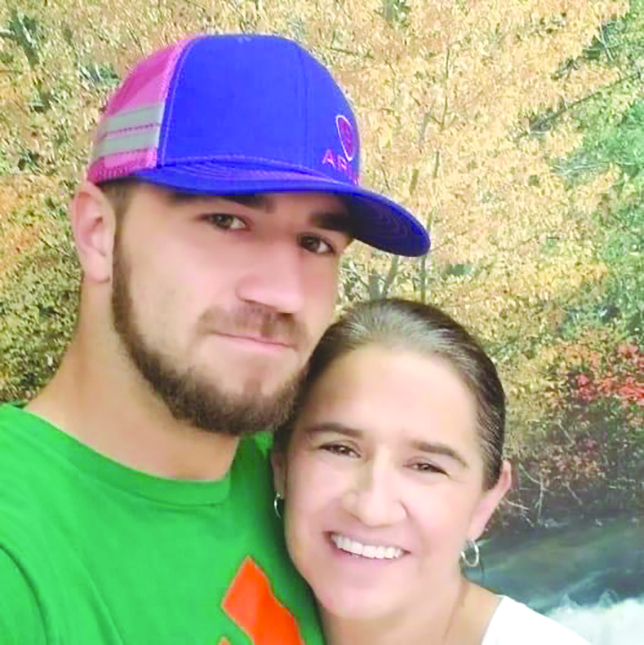
Happier times. Shellie Blackburn Hall poses with her youngest, Nick Hutchinson. Nick passed on October 21, losing his battle he wanted so badly to win. Hall’s mission is to see that drug dealers are held accountable as she continues to help those who are addicted recover.