

By Burton Cole
and Jim Thaxton
BUTLER — Perhaps the most repeated phrase was “We can do better” when three of the four candidates for Pendleton County Judge Executive squared off in the first debate of the 2026 election season March 25 at Pendleton Hills.
“I am without a doubt the least known candidate in the race,” James “Jimmy” Poynter told the crowd of 200-plus people gathered at the country club clubhouse. “But I am the most qualified.”
He continuously pointed to his 30 years in law enforcement, Fraternal Order of Police leadership and community involvement.
Anthony Strong, the former superintendent of Pendleton County Schools and a former Falmouth councilman, said, “Each of us is here today because we care about this county, and you care about this county. Personally, I think we can do better.”
Rick Mineer, a small business owner now serving as the county magistrate for District 4, said, “Leadership should be measured by results, not talk. Economic growth doesn’t happen by accident. … I’m proud of all we’ve accomplished. I’m ready to build on that.”
The fourth candidate, former Falmouth Mayor Sebastian Ernst, missed the debate. He stated in Facebook posts that a petty conspiracy blocked him from the debate. A hearing on a building code violation claimed against one of Ernst’s properties was scheduled for the same time, then was canceled without notifying him, he said.
“While this situation is frustrating, I can’t say I’m surprised,” he wrote.
The city countered that hearings are scheduled only when the property owner requests one, that this hearing was scheduled before the debate date was set, and that clearly stated on the hearing notice is that if there is a conflict, the property owner can request a different date.
City officials also said that the alleged code issue was fixed, so the hearing became moot and was canceled.
Ernst said he is hosting a meet the candidates night 6 p.m. April 6 at his business, We the Pizza, in Falmouth. He also said he absolutely will participate in the debate set for 6:30 p.m. April 8 at the Pendleton County Extension Office in Falmouth.
All four men are running in the Republican primary to replace Judge Executive David Fields, who is retiring at the end of his term this year. No Democrats field to run.
THE SETTING
Local businessman and entrepreneur Dave Bay recognized the contest as an opportunity to promote his Pendleton Hills hospitality while introducing the Republican candidates for judge executive.
Many people openly questioned serving alcohol at a political gathering. Bay clearly set the ground rules and expectations for the evening before the candidates introduced themselves, and the event went off without any incidents.
Even when responses tipped towards controversy, the attendees remained respectful.
The evening began with candidates for other county offices given two minutes each to pitch why citizens should vote for them. A few insinuated they were running to address corruption and what they believed was a lack of transparency.
For the most part, candidates new to a position shared their qualifications for office, while those seeking reelection highlighted their accomplishments.
The two-hour debate began at 7 p.m. Candidates were asked 15 questions submitted by citizens and the candidates themselves. Each candidate was given two minutes to answer each question. They were also allowed a rebuttal or the opportunity to provide additional information after each candidate responded.
At the conclusion, the candidates invited the audience to speak with them one-on-one at different locations in the hall.
The debate was recorded and posted in its entirety on Dave Bay’s Facebook page and shared on other pages.
THE QUESTIONS
Among the questions were:
• A question of utilities and infrastructure raised a question of combining services.
“We have two water districts in the county. Both are working well,” Strong said. “I’m not opposed to merging them, but if you have something that works well, you don’t ‘fix’ it.”
Mineer said that anytime the county can save money, it should. He said he doesn’t believe water districts need to be combined now, but that the conversation on duplication of efforts and services needs to begin.
“Do we need to build a $20 million water plant at this point? I don’t think so,” Mineer said.
Poynter said that one thing he learned in 30 years as a law enforcement officer is “people don’t really care who shows up as long as somebody shows up.” The county needs to begin research on ending duplication of services.
• Candidates also were asked their opinions on whether fire departments should stay separate or be merged.
“We need one unified fire service,” Poynter said. Merging departments probably will step on toes and hurt feelings, he said, “but we have to do better.”
He also emphasized the word “merge, not takeover.”
Mineer said, “Do we need to combine services? Absolutely. We’re duplicating them.”
He said that the county contracted with Falmouth for fire service for seven years, but that didn’t work out, so the county reactivated its own department.
“At the time, the city was going through transition AGAIN. The county cannot operate that way.”
Strong said that twice the county has contracted studies on how merging fire departments into one should be done. “I don’t understand why we do reports, but don’t follow them.”
He said the feuding between departments and governments is counterproductive. “Adults don’t hold each other hostage. They sit down and work things out.”
• On collaboration, Strong said, “The first thing I want to do is get together with the two mayors and work out what we need, then get together with emergency services. That’s what leadership does.”
Mineer said, “I want to get back to when every quarter we got together with the mayors, the councils and the school board.”
Poynter said, “We need to sit down and see where we are. I don’t think we know where we are.”
• Candidates were asked about public transportation for rural areas.
“I don’t see how we could do that without increasing taxes,” Poynter said, also noting that there are grants available for transportation access. He also said the county can work with Amazon to get people to doctor’s appointments and other places.
Strong said a transit system is needed, but the opportunity to build on is limited.
Mineer said Fiscal Court is monitoring a pilot program elsewhere to see how it works and if it’s something that can be applied to Pendleton County.
• A question dealing with nepotism hires noted that a 1998 law defined nepotism as when it involved spouses, children still living in the family home and anyone claimed for tax purposes.
Mineer said that he has no problem adding that to the county code of ethics.
Strong said the schools he oversaw not only had nepotism rules in place, but that they included suppliers, not just employees.
Poynter said he was surprised that it was on the books already, and that he would extend it to aunts, uncles, cousins and business partners, to which Mineer cautioned that with only 14,500 people in the county, “we’re all related one way or the other.”
• On transparency and livestreaming meetings, Mineer noted that the volunteer who had been livestreaming Fiscal Court meetings had stopped doing so. The county is in the process of acquiring equipment and will have livestreaming in place before the end of the year.
Poynter said he favors livestreaming because, “Accountability, it has to be there.”
Strong said, “We can do more. We can do better.” For example, meeting agendas should be published at least a week in advance so that anyone interested in particular topics will know on which dates they will be discussed.
• Asked whether they would use diplomacy to resolve differences of opinion even if it meant compromise, Mineer said there have been many times that not all the magistrates agreed, “but we came to a consensus.”
Poynter said, “I embrace people bringing other viewpoints to me and arguing very strongly for them. I have been proven wrong, but most of the time, I get it right.”
Strong said that early on, he would sit down with the magistrates to discuss his and their visions for the county. His job would be to take that consensus vision and make it happen.
• On the county’s role in a recreation program, Mineer said Fiscal Court is working on building a multipurpose center for recreation so that no kids would be left out.
Poynter talked about his role with the Boys and Girls Club in Foster, and what they built there during that time. “If you take care of the kids and the elderly, everything else will fall into place.
Strong said that when he was Pendleton schools superintendent in 2011, the school district, county and cities put the recreation program together and had a full-time director overseeing it. “Because of politics on the board and personality conflicts, things went south.
“We shouldn’t have a situation when we’re not working for the children,” he said.
• On economic development, a questioner asked what can be done about how neighboring counties continue to grow while Pendleton County seems to be falling behind.
“I’m the only one up here involved in bringing business here,” Mineer said.
He pointed to the success of bringing Paragon Metal Fabricators into the county to move into the building vacated when Life Fitness/Hammer Strength moved its manufacturing operations out of the county.
“We’re beating the bushes every day,” he said, noting that the double whammy of a shortage of workforce and shortage of housing is hindering efforts.
Poynter said that Kentucky is full of agencies that can help with economic development, “but let’s grow the ones we have. Small business is the backbone of any county.”
More emphasis needs to be placed on tourism with the rural setting for camping, fishing, hiking, ATV trails and the like, he said.
Strong praised the efforts of Tami Vater, who Mineer and the rest of Fiscal Court hired to be county director of economic development and tourism. “We need to provide her with the resources,” he said. That includes building and maintaining the infrastructure that will attract businesses and identifying and preparing the sites where businesses can flourish.
Photos by Burton Cole
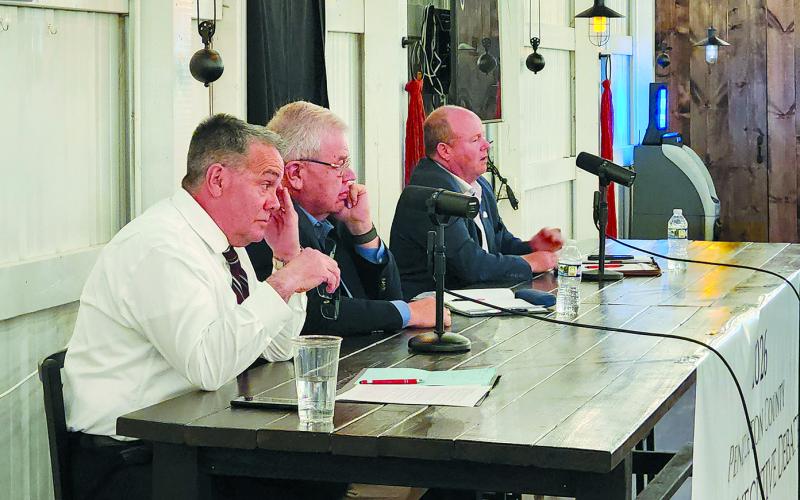
James Poynter, left, and Anthony Strong listen as Rick Mineer answers a question during a debate between candidates for Pendleton County Judge Executive March 25 at Pendleton Hills country club in Butler. The three, along with Sebastian Ernst, are vying to replace Pendleton County Judge Executive David Fields, who is retiring when his term expires at the end of the year.

More than 200 people filled the clubhouse to meet the candidates and listen to the debate.
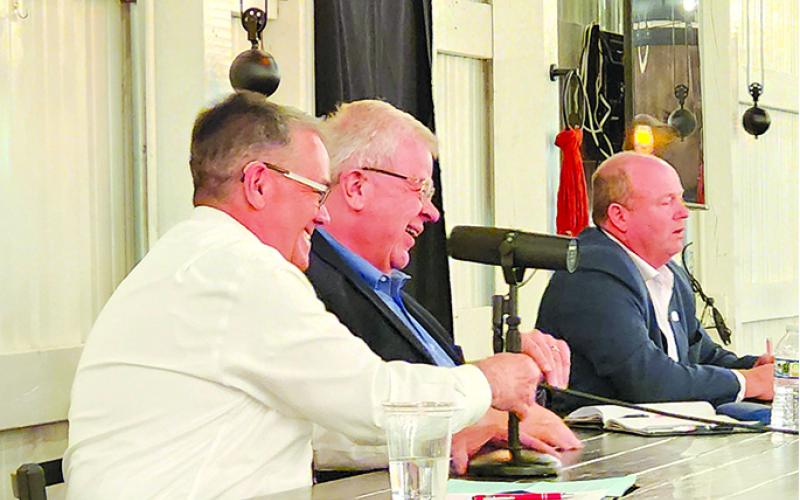
James Poynter and Anthony Strong enjoy a chuckle as Rick Mineer makes a crack during the debate.
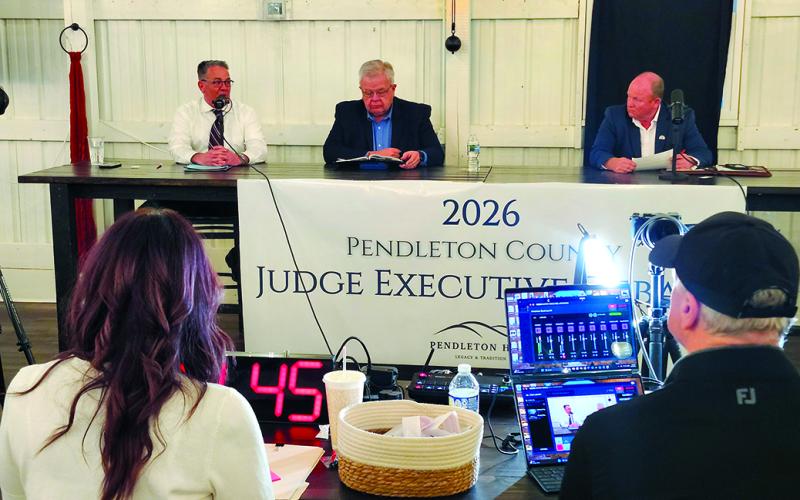
2026 PC Judge Executive Debate