

Extension Office hosting tea talk about research and prevention
By Burton Cole
FALMOUTH — As a busy mom to three active teenagers on top of her career at the Kentucky Farm Bureau, Miranda Geers thought the abdominal bloating and pressure was because of her schedule, not ovarian cancer.
“I attributed this to our busy schedule and usually crappy diet. There were some other symptoms, but I attributed that to being a tired mom of three teenagers who was getting ready for menopause,” the insurance customer service representative said.
“I had increasingly dry skin. Wrinkles were appearing on my face pretty rapidly. My hair was thinning. My joints hurt.”
After consulting with her health care professionals, Geers changed her diet, began regular exercise, and continued to try to keep up with her kids’ — Jeanna, Jacob and Joshua Craig — Pendleton County Schools teams, such as academic, soccer, archery, football and tennis.
“As the months went by, my symptoms worsened,” Geers said.
A series of doctor visits and routine exams turned up various possibilities—urinary tract infection, umbilical hernia, diastasis recti (a separation of two muscles that run along the front of the abdomen) and ascites.
Ascites is the accumulation of fluid in the abdominal area that, when present with a pelvic mass, often is a sign of advanced-stage ovarian cancer.
“At this point, I was swollen with ascites so severely that I was the same size as I was when I was carrying my twins,” Geers said.
The surgeon she was sent to for repair of what was thought to be the hernia or diastasis recti “told me that I was overweight, most likely had internal damage from carrying twins, and that I could come see her when I was ready for a plastic surgery consult.
“She told me that Target had some good quality shapewear that would probably make me more comfortable.”
A few days later, ultrasound results revealed the ascites. Her gynecologist referred her to a gynecological oncologist.
“He immediately sent me to have a paracentesis to drain the fluid from my abdomen. They drained 10 liters of fluid,” Geers said. “This was biopsied and I was diagnosed with low-grade serous ovarian cancer.”
The date was Feb. 13, 2021. Geers was 41 years old. She had been experiencing symptoms for about four months.
ODDS OF OVARIAN CANCER
According to the American Cancer Society, ovarian cancer occurs mostly in older women. About half of the women who are diagnosed with ovarian cancer are 63 or older.
“A woman’s risk of getting ovarian cancer during her lifetime is about 1 in 91. Her lifetime chance of dying from ovarian cancer is about one in 143,” according to the Cancer Society statistics.
This year, about 20,890 women will receive a new diagnosis of ovarian cancer and about 12,730 women will die from ovarian cancer, according to the report.
“Ovarian cancer is one of the leading causes of cancer deaths among women,” the American Cancer Society states.
“Ovarian cancer diagnoses have been slowly falling over the past few decades. The incidence rate declined by 1% to 2% per year from 1990 to the mid-2010s and by almost 2% per year from 2012 to 2021. This is likely due at least in part to more use of oral contraceptives and less use of menopausal hormone therapy.
“Fewer women are dying of ovarian cancer as well, likely due to better treatments and fewer women being diagnosed. The rate of ovarian cancer deaths has decreased by 43% since 1976. Most of this progress has happened since the mid-2000s,” ACS states.
GEERS’ SURGERY
“On March 3, 2021, I underwent what is called debulking surgery. I was in surgery for 9 1/2 hours,” Geers said.
“LGSOC (low-grade serous ovarian cancer) is characterized by solid tumors that grow on the outside of organs, not inside. Everything within my abdomen and pelvis was wrapped in tumors. Some of them were able to be peeled off of my organs. Some were not.
“I have a few spots that were inoperable due to their close proximity to arteries.”
Surgery included a hysterectomy, plus the removal of her gallbladder, omentum, half of her large intestine and two-thirds of her rectum.
“My bladder was also wrapped in tumors but they were able to salvage it,” Geers said. “I had a catheter for three weeks after surgery. They had to disconnect all of the nerves connected to my bladder, so it had to learn how to work again.
“My oncologist says I was only a few months away from my heart and lungs shutting down due to the pressure from the ascites.
“I now have an 18 inch scar that runs from my sternum to my pubic bone. They sent me home with 38 staples. Now, almost four years post-diagnosis and surgery, I am about as close to normal as I’ll ever be again.”
“After surgery, I was placed on hormone therapy to help control the levels of free estrogen in my body and hopefully keep my residual tumors in check. It didn’t work. I had a few new spots show up on my liver during the nine months I was on Letrozole. Chemo would be next.
“Platinum-based chemo is the only treatment approved by the FDA for LGSOC and it is well documented to be ineffective. Only 5% to 10% of patients with this diagnosis will see positive results. My doctor was able to appeal the insurance company and get permission for only three rounds instead of the typical six to nine rounds.
“The tumor remnants I still had in my small intestine’s mesenteric tissue continued to grow during my nine weekly treatments,” she said.
More appeals led to approval to try an off-label medication developed for melanoma and lung cancer.
“I was able to reach medical stability with this treatment over the year and a half I took it, but the side effects eventually became too difficult to manage. I had developed a sensitivity to staph, which caused my fingernails to become infected and split open. I had sores all over my body, but the ones on my face and head were the worst.
“I stopped treatment in July 2023 to regain some strength. Since then, I have been without any treatment meds and have remained stable, but my most recent CT shows some new tumor activity. I am trying to put off the next treatment as long as possible so I can be strong enough to help our twins get settled into college and the Marines next fall.
“My prognosis would be better if there was some kind of treatment that was actually developed for LGSOC. Currently, the survival rate is only 50% to 60% at five years. Even if I can keep the cancer under control, the chances of me needing more surgeries to be able to keep my body working are pretty good,” Geers said.
“I have already had a hospital stay due to sepsis. There’s a pretty good chance that I will eventually need a colostomy or ileostomy.
“The body I have now is definitely not the one I used to have. It is incredibly fickle and quirky. If I don’t keep a routine with my meds, food and liquids, I pay the price. The intestinal issues I have can make it difficult to leave home. I do my best to keep up with the pace of life, but if I don’t get a day to rest every now and then, I crash pretty hard.”
LESSONS LEARNED
“The most important thing I have learned through all of this is that advocating for yourself is a must,” Geers said. “I have no family history. No genetic mutations. Absolutely nothing would have pointed to ovarian cancer under normal circumstances.
“If I would have been more knowledgeable about OC and the symptoms in general, I probably would have sought out help sooner. There were a few medical professionals who were inclined to keep asking questions, but they weren’t looking for any kind of ovarian cancer either. There was no reason to.”
Routine screenings are important to catch the cancer in its earliest stages.
“If I would have had to do this on my own, my current situation might be much different.
“For a while after surgery, my husband and I had some help with getting the kids to practices and with some meals. During my three months of chemo, I had a different friend take me every week. My husband helped me stay on top of my meds. I have an amazing circle of friends who won’t let me fall.
“I am also incredibly thankful for the new community I have found with Hope Warriors. I wish I would have had access to a group like this sooner, but I am certainly glad to be a part of it now.”
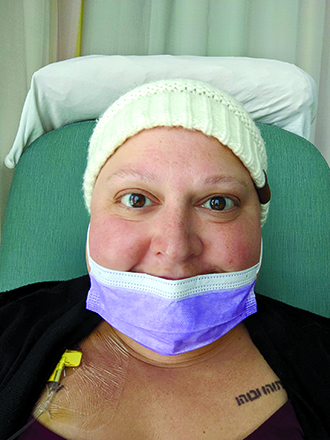
Miranda Geers of the Falmouth area smiles while undergoing a chemotherapy treatment. Geers was 41 — more than 20 years younger than normal — when diagnosed with ovarian cancer Feb. 13, 2021.
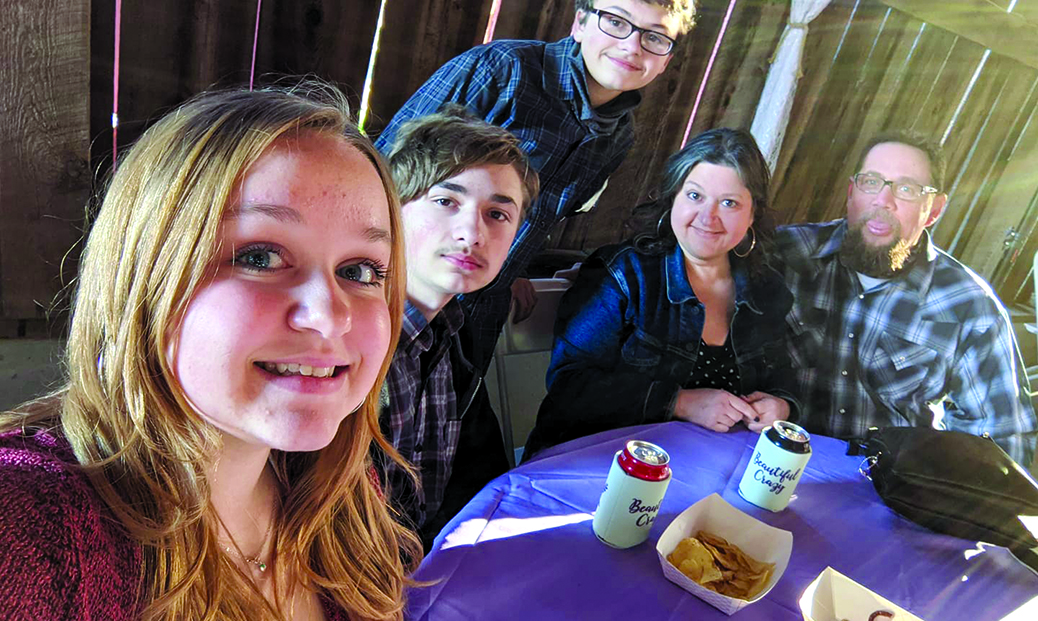
Ovarian cancer patient Miranda Geers of the Falmouth area enjoys time with her family, from left, daughter Jeanna Craig, sons Jacob and Joshua Craig, Miranda, and husband Andy. Photo courtesy of Miranda Geers.
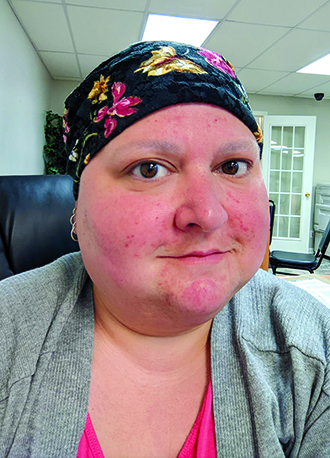
Miranda Geers thought the abdominal bloating and pressure was because of her schedule, not ovarian cancer.