

Poll says people are willing to pay more for emergency services
By Carolyn Reid
An informal Facebook poll conducted by the Falmouth Outlook led to some surprising results: in a day of inflation and, in some ways, financial uncertainty thanks to our elected officials in Washington, the majority of those responding to the poll indicated they are willing to pay to have a county-wide fire district with the goal of having a paid staff, and they would also pay to keep dispatch in the county, a thought PC Fiscal Court is reluctant to consider.
As of the end of the boosted poll at 11 a.m., the percentages were 73.6 percent in favor of paid fire, and 68.5 percent for dispatch. Two hundred thirty-nine PC residents responded. The poll ran from Thursday and was boosted Saturday. It ran till 11 a.m. Monday morning.
While the news broke via Facebook earlier in the summer that the court was looking into sending dispatch to KSP, an investigation that had been underway for a while then, according to the court, the county fire department was much less surprising. During the joint meeting of the court and Falmouth City Council, Magistrate Rick Mineer declared the county would form its own fire department after Falmouth Mayor Sebastian Ernst insisted the county pay $225,000 for county fire coverage from the city. An earlier interlocal agreement, made with members of the court and council, had set the pricing at nearly $100,000 less than that number.
The new proposal, developed by another committee of city officials, was sent to the court after the original agreement, leading to a joint session. While Ernst stuck to the $225,000, council settled for $150,000 from the county with the understanding the court would take strides to set up its own department in a little over a year. That led to a year-long agreement with the city and the county with $150,000 as the price paid by the county. After the year, the agreement will be on a month-to-month basis until the department is in place.
During that meeting, Ernst offered the city’s fire department to the county, an offer that was rejected with the argument it was not a suitable location for the county. He also offered a location at the south of town, the Klee property. Judge/Executive David Fields stated that would present a problem because it was still within city limits.
Since May 31, the fiscal court has pursued its plan of installing a fire department that will be located in the county. At this time, the place looks to be approximately five minutes north of current station and about one mile north of the city limits. Darrin Brown was quickly installed as the interim fire chief, and, according to Mineer, the department has come together with enough volunteers to form a department.
Last Tuesday, the court also voted to purchase a pumper truck for $50,000 and an aerial (ladder) truck for $20,000. While Magistrate Josh Plummer says the pumper truck is in great shape with low miles, he and firefighters such as Jason Bowling of the Northern Pendleton Fire District Board and Bobby Pettit, retired fire marshal who also sits on Falmouth City Council, expressed major concerns about the aerial. Plummer voted against its purchase due to the fact the company (Grumman) is out of business and parts are hard to come by if repairs are needed.
Pettit, who has driven the truck, and Bowling both stated the truck is impractical for any roads but U.S. 27, and the only place it could be used is at Butler’s Industrial Park. Bowling has repeatedly expressed to the Outlook that the truck would require more water pressure on a long-term basis than the county can provide. (Wayne Lonaker, the head of Eastern Pendleton’s Water District and Austin Monroe, the head of Pendleton County Water District, both insist most of the hydrants could provide the needed pressure.) Pettit’s concern lies more on the skills needed to maneuver the truck since it is so large.
Plummer is also frustrated because a smaller and what he deems a better truck for the county is on a government bid list at $2,000. The company that made that truck is also still in business, making repairs and parts more easily accessed and affordable.
Magistrate Josh Plummer said the department, once it is established, should cost the county approximately $300,000 per year. “There is a possibility after the facility is built, it could be run around $200,000 or less” if no major repairs are needed for the equipment.
ARPA funds totaling close to $1 million are set aside for the land, the building, and other start-up.
All of this has led to many questions from the county. County-wide, many wonder if dispatch is being pushed to KSP in order to accommodate the fire department. The savings from dispatch would theoretically give the county enough to cover the $300,000 and maybe a little more.
The city worries about its fire coverage. Fire Chief Dave Klaber could not give the Outlook a number regarding the costs after the monies from the county stop flowing in, but he took action approximately a week ago to keep his department manned.
A call made by the judge to the Outlook revealed Klaber had instructed his volunteers they were not to volunteer in any other departments. When the Outlook contacted Klaber to clarify, Klaber replied, “When you have people on multiple departments, they spread a lot of departmental business that doesn’t need to be spread to other departments.”
Then, he addressed the concern that is more relevant to the city down the road. “It also makes it hard on runs with multiple departments because you don’t know who you’re going to get and who you’re not.”
Klaber’s concerns address an additional question from another volunteer fire department in the county. Northern Pendleton Chief John Seitz states he cannot get volunteers at NPFD. Falmouth, while well-staffed, is stretched at times. Seitz laments the days of volunteering are fading, especially when the volunteer’s life is on the line.
(Also, the current fire departments were set up in a time when many worked either on their local farms or in the town. That has changed, as well.)
Northern Pendleton’s district is also concerned about being taxed for a county-wide department when it comes from the general fund. The district pays the 10 cent tax for its fire and another 10 cents for its ambulance, leaving them to pay more than the rest of the county. They perceive they have been taxed twice for the services considering they are paying into the same general fund that pays for the county, regardless of if the county makes a department or if the city covers the rest of the county.
From another view, Falmouth Mayor Sebastian Ernst proposes the city would work with the county this way if the county would take over the established department:
-County buys and assumes full control over the cost and operation of the current FD. (Cheapest and quickest path)
-Falmouth will cover the $500 cost of all calls within city limits so Falmouth citizens aren’t billed for calls. This expense will be covered under our current tax rate.
-It would be required that a fire station remain in city limits.
-Creation of an eight-member board with two appointments from each city and one from each district to ensure fair coverage and representation county wide.
-Funding would come from the current county general fund, no new taxes. The cities would fund the calls to their jurisdictions ($500/run) and county citizens would pay their own.
-$500 x 300 runs = $150,000. The current FD budget is only $280,000 so it would only be a $130,000/year expense to the county after the cost of buying our facility. This is cheapest possible way to make this happen and keep the exact same coverage.
-Falmouth makes up about 100 runs/year so we would be paying the county $50,000 a year and the citizens wouldn’t have to worry about the expense. This would cut our cost by 75 percent compared to what it was just last year and we would get the same service.
In the case of any emergency service, personnel is hard tom come by; that means pay would have to be comparable to surrounding counties for a paid department to be a viable option.
Dispatch
While the percentage of people willing to pay for dispatch is a little lower than those willing to pay for fire, those who are willing to pay are once again in the vast majority.
While $75 was named as a maximum based on neighboring counties, the fee could be much less if the county would consider imposing it.
While Grant County’s Judge Executive Chuck Dills in a recent discussion with the Outlook praised their decision to merge their local dispatch with Kentucky State Police, Pendleton County seems to be more concerned about the move.
A topic that has been kicked around is the number of dispatchers at KSP. The plan, from what has been related by fiscal court, is to add one more dispatcher per shift onto the KSP staff. This dispatcher will not be dedicated to Pendleton County, but will be added to decrease the workload.
At this point, our local dispatch runs with two people, and in critical times, three people, to maintain the workload. The dispatchers work together to complete the calls and to instruct the caller in handling the situation. The concern is that three at KSP dispatch will not be enough to cover KSP, Robertson, and Pendleton Counties. (Nicholas County is also considering the move to KSP Post 6.)
Moving dispatch to KSP will theoretically save the county approximately $300,000, but questions remain in the county: If the workload is deemed to be too heavy for three, would another be added from Pendleton to cover? How well will the dispatchers there know the people and the roads? If a call comes in where law enforcement backup is needed (and that is routine at some addresses), who will send law enforcement ahead of the ambulance? Even from a business perspective, what would the cost be to the county when 10 of the current dispatchers live here and do business here, considering groceries and restaurants are more numerous around Grant County? For that matter, how many from our local dispatch, who know the areas and the people, go to KSP to work?
These questions seem to be why people are willing to fund dispatch. While Magistrate Rick Mineer holds that 70 percent of the county does not even know where dispatch is, nearly that many want it to stay where it is.
While dispatchers are paid, their pay in the county is not comparable to the pay at KSP or in any of the surrounding counties. Dispatchers, like firefighters and EMS staff, are hard to come by. Those who are in our dispatch are mostly residents of the county. All dispatchers, full-time and, more recently, part-time are required to train at the academy in Richmond for four weeks. After they are trained, they are contracted to work for our dispatch for three years in order to compensate the county for their training.
A committee including Angie Wright, head of dispatch, and others will meet with KSP’s head of dispatch Tuesday before the 6 p.m. caucus to clarify what services their dispatch can perform due to questions that arose at the caucus two weeks ago. Discussions about dispatch will once again happen during that caucus. The public is invited and encouraged to attend.
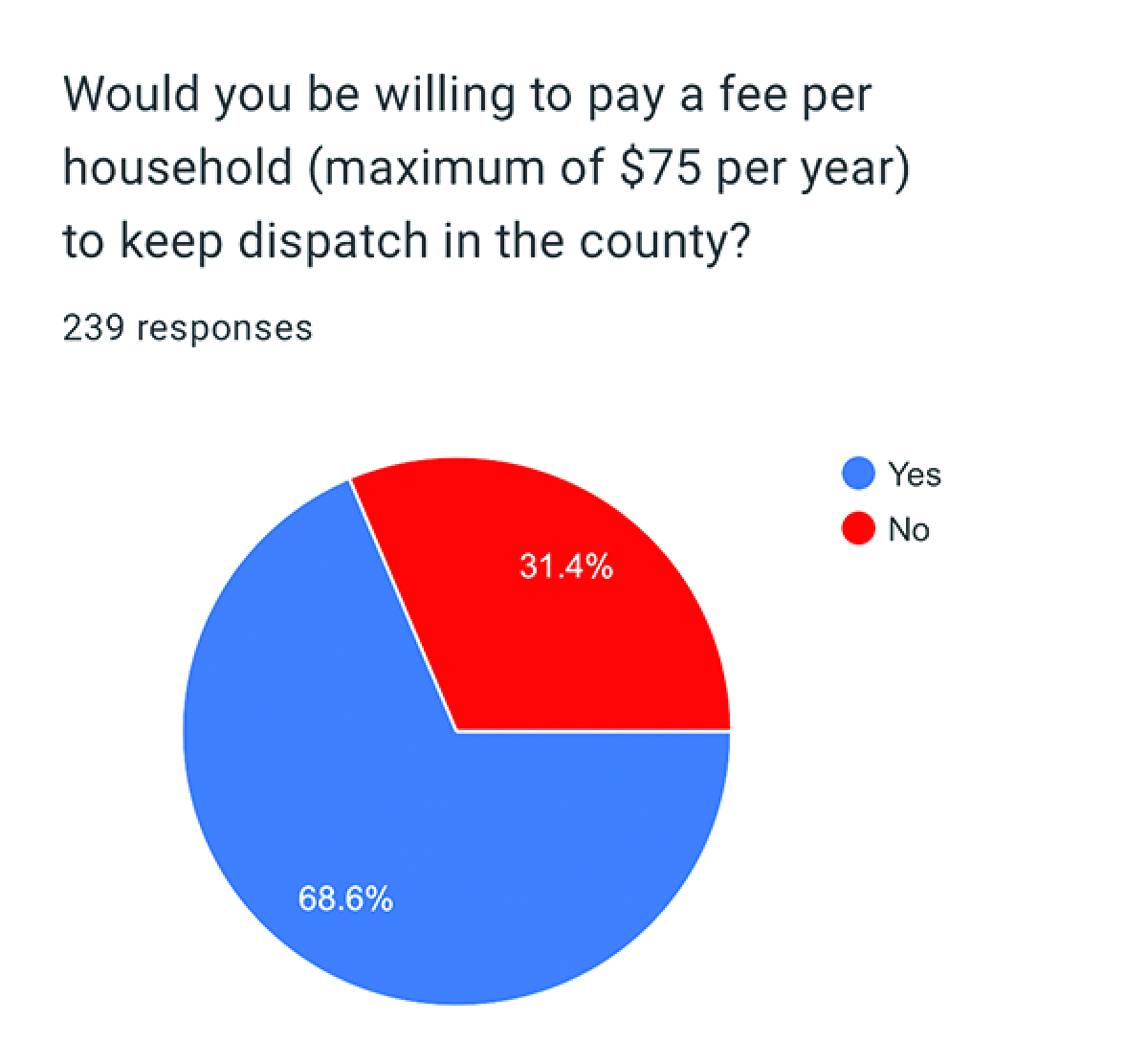
The numbers reflected above remained quite stable during the time the poll was run from Thursday afternoon through Monday at 11:28 a.m., with the fire tax always being more widely favored than the dispatch fee, but even dispatch remained steady, hovering around the 70 percent mark.
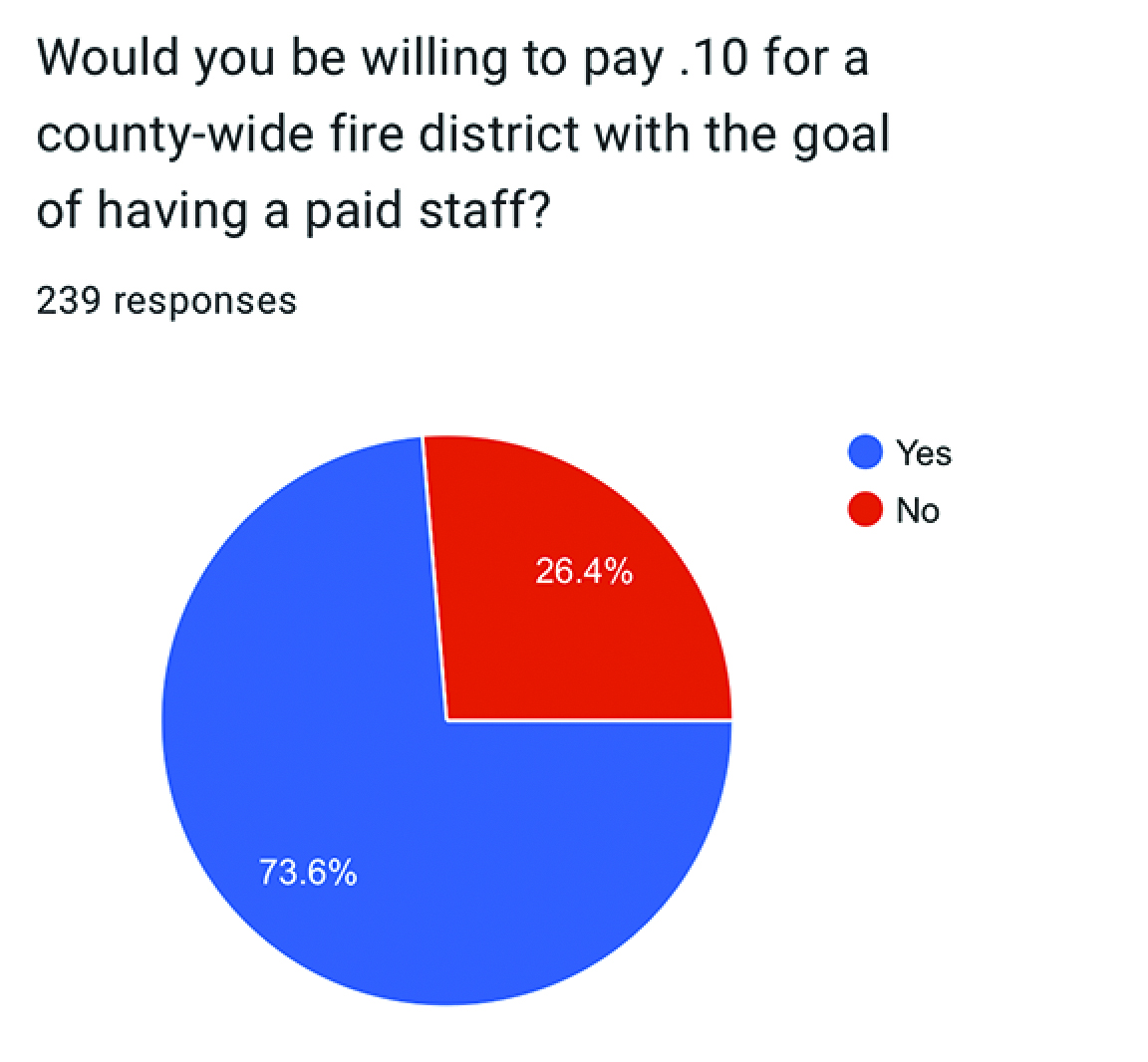
The numbers reflected above remained quite stable during the time the poll was run from Thursday afternoon through Monday at 11:28 a.m., with the fire tax always being more widely favored than the dispatch fee, but even dispatch remained steady, hovering around the 70 percent mark.