

By Carolyn Reid
A Pendleton County woman appeared in court Tuesday after being cited for having a small monkey (specifically a marmoset) on the premises, a violation of Kentucky law.
Fish and Wildlife officers obtained a warrant to search the home of Jeannie Price Wilson, located on the line of Pendleton and Grant Counties, after a doctor reported to Three Rivers Health Department that they had seen a child who had been bitten by the monkey. The bite is said to have occurred in April, but was discovered around May 18 when the child told her doctor it had occurred. Her grandfather states he was unaware of the incident until the time it came up in with the physician. He said the girl told him she had washed the site and had put a topical antibiotic on it, but she nor the owner had reported the bite to him when it occurred.
He said that report to the doctor is what spurred the action by the health department and by Fish and Wildlife.
Lieutenant Chris Fossitt, an officer with the Kentucky Department of Fish and Wildlife, issued the search warrant for Wilson’s home May 18. The marmoset and its equipment were turned over by another Fish and Wildlife officer the next day, according to the warrant’s execution date.
The monkey was later euthanized in order to inspect it for rabies. Justin Pittman of Three Rivers Health District, handled the case for the health department. He explained, “We handle animal bites, whatever they are. By law, once a medical office has seen a patient who has been bitten, the bite has to be reported.”
He explained domesticated dogs and cats are handled with a quarantine situation. They are held for 10 days in a controlled setting, usually at home, and are watched for signs of infection. Wild animals, if they are caught, are euthanized in order to examine their brains to see if they are rabid. Animals that are not caught are assumed to be rabid, and treatment starts for the person who is bitten.
Rabies is 100 percent fatal, reminds Pittman, if treatment has not begun before symptoms develop.
Incubation periods in animals can vary from one week to even a year. That was the problem he and his office dealt with as they handled this case of the marmoset.
“We have no record of how long the incubation period is for a monkey,” Pittman said. Furthermore, they have no record of where the monkey originated or what other diseases it may have carried.
Regarding the situation, Pittman said, “It’s a shame. It’s sad. An animal lost it’s life, but human life comes before an animal.”
The warrant states this was the second time Wilson’s home has been searched for the primate. She had removed it prior to executing their first warrant. No date was given as to when that search occurred; however, pictures of the animal were found on electronic devices in the home.
Wilson was arraigned Tuesday on charges of Propagation/Holding of Protected Wildlife, a violation of KRS150.280. She will be subject to random inspections by animal control for one year. Her pretrial conference is set for June 6.
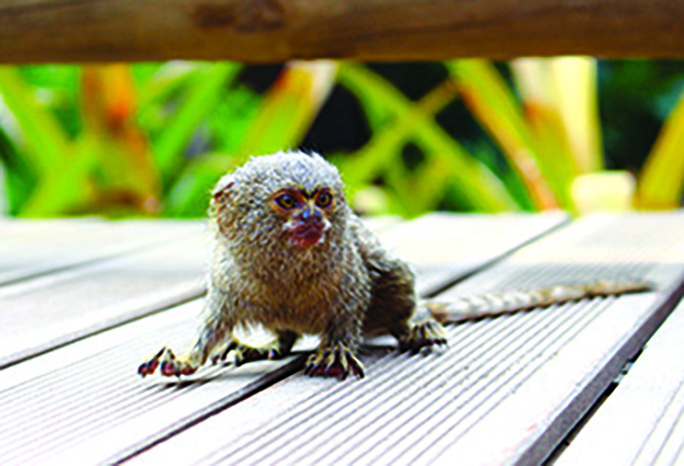
This stock picture of a marmoset shows the approximate appearance of the animal that was seized from Jeannie Wilson’s home last week. While they are small, they have high tempers and can bite, scratch and attack, according to the website, Animals Around the Globe.