

By Carolyn Reid
For a period of time until 1980, Pendleton County had a traditional community hospital. In 1980, St. Elizabeth bought the site, and it became a care unit. At that point, the county became more dependent on emergency medical services, and ambulance runs became more common and necessary.
Even today, the nearest hospital is over 30 minutes away from most places in the county, and many calls each day require life-saving techniques that are specialized and costly.
The situation here and in other counties like ours is what pulled Jody Dunhoft, the director of the Pendleton County Taxing district, to Washington a few weeks ago.
Dunhoft is known for her advocacy at the state level, working last year with Rep. Mark Hart to save EMS as we know it as an example. She has deep knowledge of the on-going issues rural ambulances and rural health care face. This knowledge, along with her advocacy, led to an invitation from the Kentucky Office of Rural Health to attend a conference in Washington, D.C. where she could address the problems rural health care faces.
“You gotta understand,” she starts. “It is incredible to see ‘Rural EMS’ in print.”
She refers to the documents she received at the conference, a place where little in the way of medical first response teams have been acknowledged. While rural hospitals have been on the agenda for 25 years, other aspects of rural medical care have taken more of a back seat.
Now, the National Rural Health Association Farm Bill is taking emergency medical care into its consideration of what needs to be supported as well as other needs that are uniquely problematic in rural areas: behavioral health, broadband services, nutrition, and rural development funding to “support rural hospital capital development projects.”
Dunhoft met with Sen. Mitch McConnell’s staff to discuss the role of emergency care in counties that are far from hospitals when time is of the essence. The goal of her participation in the conference was to “help…make connection with representatives from your district and to be a resource for them to reach out to when they might have a question on how a policy or law that could help or affect your service,” her invitation stated.
One goal of the National Rural Health Association is to fight for rural health equity, the literature says. The document says, “Rural populations often encounter barriers to health care that limit their ability to obtain the care they need. COVID-19 has devastated the financial viability of rural practices, disrupted rural economies, and eroded the availability of care.” It goes on to acknowledge federal health care spending is critical to rural Americans, and the goal of the programs are to “expand access to health care, improve health outcomes, and increase the quality and efficiency of health care in rural America.” This expansion includes maternal health, telehealth, addressing obesity and chronic conditions, and expansion of access and increased funding for emergency medical services.
The EMS part is of course where Dunhoft offered her input, and her focus was the federal funding aspect. Not only was her audience more capable of making strides in this area; the areas of Medicaid and Medicare funding for ambulances offer some of the largest barriers to the EMS program in rural areas. She shared statistics for Pendleton County to illustrate her point.
Dunhoft’s statistics for 2022 illustrate the problems rural EMS encounters:
Forty-five percent of the transports in PC were Medicare and 22.5 percent were Medicaid. The runs under these two funding sources amounted to nearly $1.1 million in costs. The programs paid the ambulance service less than $500,000 for those runs; the service here were required to write off over $660,000, a 60.2 percent write-off.
Of the 45 percent of the Medicare payer source, 37 percent of the runs are traditional Medicare and 63 percent are Medicare Advantage plans. Those plans allow copays ranging from $175 to $290 depending on the plan.
Medicaid pays $110 for advanced life support emergencies and $82.50 for a basic life support emergency. “If the primary pays more than they would allow, no additional payment will be made on the claim. This impacts 26 percent of the population.” This means claims have to be written off and not billed to the patient.
“The other 74 percent who do not have secondary insurance, only 22 percent of the patients actually made payments on their co-payments.”
To add to the funding deficit, rural counties can only bill loaded miles. The trip to the scene as well as the trip back from the hospital cannot be billed. When an ambulance in the Pendleton County area normally travels a minimum of 20 miles to a hospital, the costs to the truck count up quickly. Dunhoft states the average trip to and from the hospital is 80 miles.
Hospitals are reimbursed much differently because they are seen as providers while Dunhoft says the ambulance services are seen as suppliers. They take people to hospitals for care; however, she argues that they are actually providers just as hospitals are. “If we have a full arrest in the field, we do the same things doctors and other medical staffs do.” Insurance, though, reimburses hospitals to a much greater amount than they do ambulance staff who performs the same life-saving techniques.
“It is crucial Congress funds and provides adequate resources to rural services like ours,” she says. “And when we look at why we went (“we” meaning people from Kentucky and from parts of rural care all over the country), this is your ‘why.’”
While she says they wish to expand access and increase the workforce that is increasingly short, just as it is in almost every medical field, she is encouraged that people are listening. “This is a pivotal point,” she acknowledges.
She and her staff still work to make the service stronger even as it struggles with staffing and the normal workplace issues like illness and, yes, funding, but she was also encouraged to see so many from across the country be involved in working to change things for the people they serve. To her, it is only right, especially as she considers the seniors who have contributed so much.
“People who worked their whole lives to care for others are now concerned about what it will cost them if they have to have an ambulance run. Now, we should care and advocate for them.”
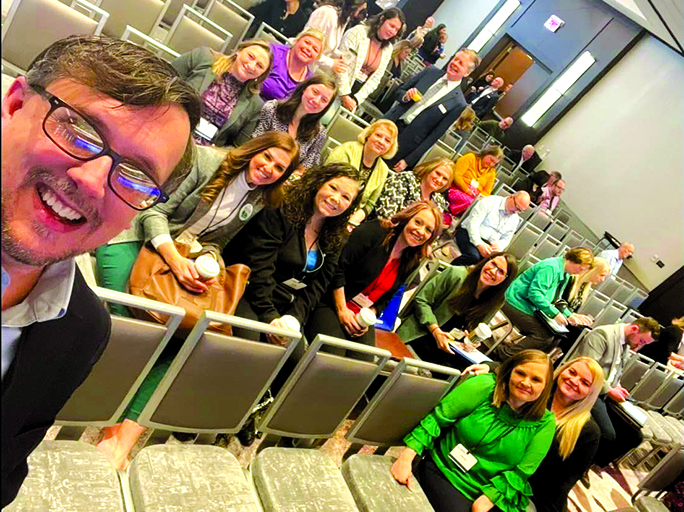
Dunhoft was one of 21 rural health care workers who represented Kentucky in Washington the week of February 7. She expressed the opportunity was wonderful for Pendleton County and how the future in rural health care can change.