

By TOM LATEK and MARK MAYNARD, Kentucky Today
FRANKFORT, Ky. (KT) – Gov. Andy Beshear vetoed five bills passed by the General Assembly, including three which would limit his emergency powers during a pandemic.
All five were priority legislation for the Republican supermajorities of both chambers and they have the power to override the governor’s vetoes. The governor said he would send a letter to hopefully begin more discussion.
“Issuing a veto is my constitutional obligation as governor,” Beshear said. “And it’s my job to issue those vetoes with veto statements when I don’t think something is constitutional when I think something will harm Kentuckians.”
Beshear vetoed House Bill 1, Senate Bill 1, Senate Bill 2, and House Bill 5, all of which would move power from the executive branch to the legislative branch when dealing with emergencies, such as the coronavirus pandemic.
He also vetoed House Bill 2 that gives the Attorney General authority over enforcement of abortion laws.
Beshear said would send a letter to lawmakers in the next day or so to begin discussions of possible compromise.
“We're going to see if there is common ground that doesn't violate the constitution,” he said. “That gives the flexibility we need for what appears to be a mutating virus. And we're certainly going to do our part ... about different options we think are going to be there.”
Republican House Speaker David Osborne said the governor’s actions, while not unexpected, were disappointing.
“House Majority Leadership will reserve comment until we determine whether the Governor is sincere in his desire to work with us,” he said. “After all, 10 months of unilateral decision-making and unchecked spending has provided evidence otherwise.”
Beshear said SB 1 interferes with the Governor’s power and constitutional responsibility to confront emergencies. It allows the General Assembly to exercise power outside of session and forces the Governor to call it back into session, in the event of an emergency, and the bill provides an inferior executive officer, the Attorney General, the power to approve or disapprove of the Governor’s decisions.
Beshear said it would also come at a cost for taxpayers. If the General Assembly approved the Governor’s emergency action in 30-day increments, with no Saturday meeting days and five days to pass a bill or resolution through both chambers, special sessions would cost $65,000 per day. That would be $325,000 per five-day session and $3.25 million for 10 sessions, he said.
HB 1 would mandate businesses, non-profits, schools, and others could follow the weaker of guidelines set by the Governor in an executive order or by the Centers for Disease Control and Prevention.
The governor said HB 5 is unconstitutional because it would “…prevent [the Governor] from executing new laws passed by the General Assembly or the United States Congress that require new or different governmental structures to carry out. It would also disqualify the Commonwealth from federal grants that may require a new office or commission.”
Osborne said the Republican representatives were following the will of their constituents.
“We approach any collaboration with a commitment to ensuring that the voices of Kentuckians across the state are heard,” he said. “These men and women expect their state to provide the information and resources they need to safely navigate this virus without inconsistent shutdowns and arbitrary orders. They were heard loud and clear as their Representatives voted overwhelmingly in favor of each of the bills vetoed by the Governor and we stand ready to override these vetoes if necessary.”
Osborne made reference to Beshear’s veto of HB 2, legislation that grants the state’s top law enforcement officer the authority to enforce the state’s laws and regulations where it concerns abortion providers.
“This is the second veto of this language by a governor who consistently claims he is trying to save lives,” he said.
In his veto message of HB 2, the governor wrote: “Given the divergent views on this legal medical procedure, it is also critical to have an impartial regulator.”
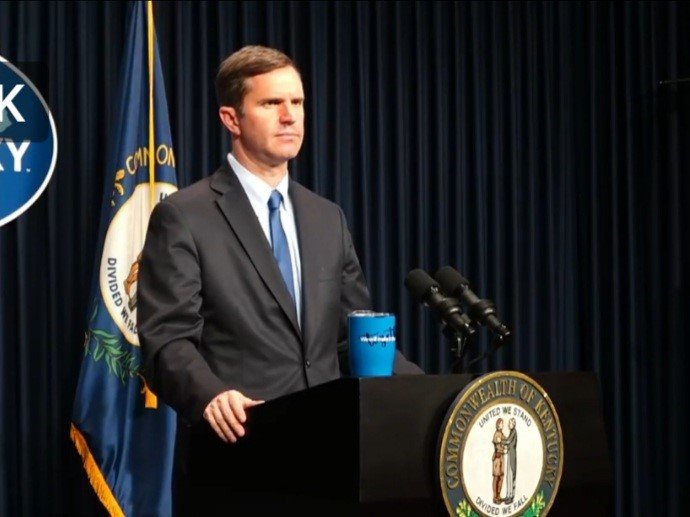
Governor Andy Beshear/Tom Latek