

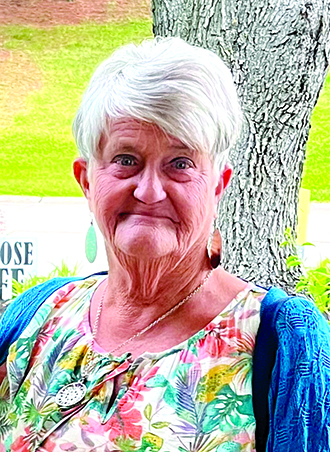
By Jemi Chew
FALMOUTH — Before computers streamlined writing and layouts into one small machine, there were headliners, addressographs, typewriters and an assortment of tools, machines and processes that resulted in the physical copy of the newspaper.
Operating these technologies required a lot of time and effort. Even preparing the newspapers to be mailed required a personal touch.
“We used to do the stuffing of the newspaper by hand,” Debbie Dennie, a retired longtime editor of the Outlook, said with a laugh.
“That was a very dirty job because you’ve got all of that ink on your hands. And if you weren’t careful, it would be on your face and on your shirt,” she said.
Dennie joined the Outlook in 1981 as a part-timer in the typesetting department, meaning that she would type all the articles on film using a compugraphic machine. The film would be run through a processor and then hung up on a clothesline to dry, similar to a darkroom. Afterward the story would have to be proofread before being arranged for the paper.
“Really, I applied for a part-time job,” Dennie said. “But it never was part-time.”
Eventually she was promoted to the advertising composition department. During that time, the backroom was off limits to women except for those making up pages on the tables. But after one of the men retired, the position was open, and she was asked to fill it.
“And that was the first time a lady had held a position with the newspaper in the typing and offset of the ads,” Dennie said. “And then when I would go out at first in the town or community, I would go out to solicit ads and stuff, and it took a little bit of a while for the advertisers to think, ‘Oh, she’s gonna be OK.’”
When Warren J. Shonert, the founder of the Outlook, sold the paper to Delphos Herald in 1986, a new age began.
“After Mr. Shonert retired, we didn’t keep anything on,” Dennie said. “They took an old sledgehammer to the line, and it broke my heart when they came in that day and did that because that was an era, you know, that was gone.”
THE FLOOD
In 1988, Dennie became editor of the Outlook.
“I took it, not really knowing that instead of being full time, it was gonna be full time plus,” Dennie said. “But that’s all right, we made it through those years.”
She made it through 33 years, covering all sorts of stories across the community. But one of the most memorable periods of her career was having to navigate the flood of 1997.
“When I got up, I think it was Sunday morning, and went back into town. You just cannot describe what it was like looking out in that water,” Dennie said.
She recalled a Dairy Queen sign that was covered in washed up homes and vehicles.
The Outlook was not spared from the flood either.
“That was a trying time because I had to try to think how in the heck we were going to print a paper because our computers had been ruined and all of the other things,” Dennie said.
When Dennie was able to get to a place that had cell service, she called a friend who was the publisher of the Cynthiana Democrat to see if they could use their computers.
“I guess in communities that are small like this one, I was good friends with a lot of the other publishers and editors of the newspapers,” Dennie said. “It was more of a personal thing, I think, than what they would do today.”
The six-page paper was two days late but featured pictures of the flood and some historical facts. And while the press day crisis was over, there was still the question of how the Outlook was going to continue operating — which ended up being in Dennie’s basement.
“So, the main office sent computers, I called the printing company to get the copiers, and they brought us a new one,” Dennie said. “We had it set up downstairs as an office and you go down there before daylight and might not come out before dark.”
This lasted for around 12 weeks, with people coming in and out of the house to pay subscriptions and change their address, and materials being loaded and unloaded in the driveway.
Eventually the Outlook transitioned back to the office, though that was also a difficult move as a lot of work had to be done to the building.
“We got through it,” Dennie said with a laugh. “I don’t ever want to have to do it again, I said. I did it that time but gosh – it was a struggle.”
COMMUNITY JOURNALISM
“Many, many of the newspapers that were put out was copy and history of whatever county they were in,” Dennie said. “We had people come in and ask questions about a certain thing that happened.”
This was when people could not go onto the web to look for answers, so they had to sort through physical books at the Outlook.
But some things have not changed, such as a community-focused newspaper.
“Sometimes the news now don’t, you know, they don’t get some of the smaller things that is going on,” Dennie said, referencing bigger media outlets.
Dennie and her team covered all sorts of stories, such as articles to encourage the public to donate supplies when families lost their homes to fire or tornados, features on well-liked or well-known community members and coverage on the Pendleton County Sheriff’s Office when deputies were rounding up marijuana users.
“I’ll tell you one thing that happened in later years. There is a place on Shelby Street called Back Inn Time. She would have people from all over and she’d always call me and let me know,” Dennie said. “It was interesting reading some of her information history as to those that had stayed there.”
Then there was the flood of 1997, and the Outlook covered its impact and all sorts of stories about those who helped the community rebuild.
“The newspaper, well, not just ours, a lot of the weekly newspapers — I call them the history book” Dennie said. “They record a lot of what is done or happens in the county, so that hi