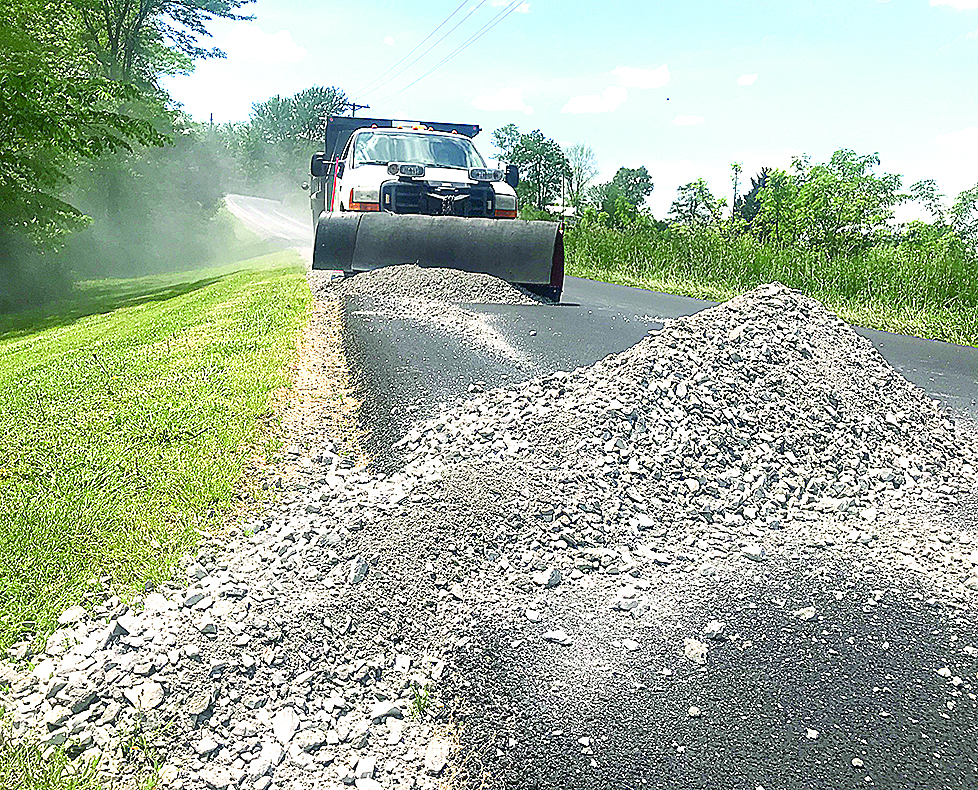
For over a year, Pendleton County Fiscal Court has been discussing the problem of shoulders on county roads and the issue is getting worse, not better, listening to the discussion at the May 18 caucus of Pendleton County Fiscal Court.
Several magistrates are hearing from residents who have had to get off the road while meeting an oncoming car and then hearing the edge of the asphalt drag across the underside of their vehicle while they attempt to get back onto the road.
While the court was discussing the roads in their districts being considered for blacktopping and the court seeking bids, District 2 Magistrate Josh Plummer repeated his question from the previous week, “Can we bid them with and without shouldering.”
Judge Executive David Fields said, “We can put that in there.”
He further explained. “There is a safety wedge that has been in there but when the roller comes through, it smashes it out and takes the wedge out.”
Plummer was recently on a golfing trip in Western Kentucky and was impressed with the county roads in Marion County and shared photos that he had taken with other members of the court.
County Road Supervisor Eddie Rarrieck was on-hand to answer questions that the court may have and explained that part of the problem is that over time, the roads have widened and, where the shoulder used to be, sometimes it is now gone and there is no place for them to drop gravel.
District 3 Magistrate, who has been pushing for a shouldering machine since he took office said, “We have to do something. We cannot just leave ditches deep and expect people to be happy.”
He shared a story from a resident who had cows in a trailer that had to go off the road and the cows were thrown around inside the trailer.
Plummer shared that he had been contacted by a lady who had to drop off the road on Buckeye Hills and drug the bottom of her call. In his career with auto sales, he shared with the court that average curb height of a car is six inches and some of the drop offs are much more than that.
Gregg told Rarrieck, “What you did on Fishing Creek, people were thrilled to death with.”
Fields showed the court two shouldering machines that he was looking at and both were from Southern Kentucky. One cost $33,000 and one $40,000.
District 1 Magistrate Alan Whaley brought up the question “Why are we getting these dropoffs?”
Rarrieck pointed out that they have not been cutting off shoulders and that in some locations, there are no shoulders there.
“You can fill them up with dense rock but then it creates a dam and pushes water back on the road,” he added.
Plummer felt that the responsibility to provide a solution should fall with the blacktopping companies that are getting the blacktop contracts.
“At the end of the day, they should offer what they can do. We pay them all that money and they should provide information. They are the experts.”
There was discussion about what would be an appropriate drop-off with Rarrieck indicating three inches would be appropriate.
Whaley suggested that the bids could include “the road edge exceeds three inches then the company must fix it.”
Fields presented a list of oils that the court would include on the oil products bid list.
The court also discussed the maintenance agreement with Debra-Kuempel concerning the Justice Center maintenance. Fields indicated that the agreement had a 2% increase and wanted to change the schedule on which three days they would be at the Justice Center. Two years ago, the agreement was for $15,697.56. Fields pointed out that the maintenance contract was more than HVAC services but maintenance for the building. He gave light fixtures and doors as examples but pointed out that they could charge extra for fixing items that exceeded the three days they were in the building.
District 4 Magistrate Rick Mineer inquired on whether the agreement was up for bid while Gregg said he leaned toward putting it out for bid.
Mineer asked when was the last time it was put up for bid and Fields answered, “It has been awhile.”
The discussion centered on whether local businesses would be interested on bidding to which Mineer pointed out, “May not want to because of the computer system that is used.”
Fields warned that the agreement has a $50 per hour plus 2% increase and his research indicated that the present bill rate is $90 per hour. A rebid could see the per hour rate increase above what Debra-Kuempel had in the contract.
Whaley wanted to confirm that the rate they pay is for labor only and supplies were billed separately.Fields confirmed it and further answered Gregg’s question that it would be reimbursed by the state.Whaley asked what they were over and Fields felt it was somewhere between $20,000-30,000 but did not have the exact figure.
To Whaley’s question, Fields indicated that they have had no troubles in dealing with them.
During the discussion, Fields noticed that the contract expired on May 15 but that it could continue with both parties agreeing while the court decides on a new agreement. He did add that it would be on the agenda for the regularly scheduled meeting on Tuesday, May 25.
The court had moved the janitorial agreement for the Justice Center to a local company, Commercial Cleaning Services owned by Scott Heringer in October. He said, “I’d like to move these renewables to June and look at them at one time. They are all over the place right now.”
In other business, he would be recommending a $2,500 donation to the youth fair as they have been doing and the agreement with PDSKC for mapping of Pendleton County has increased from $10,000 to $20,000. Fields said, “In 2004-05, it was $10,000 and up to $20,000. This does not mean it will all be spent but the new administration has increased the rate they are charging us.”
In response to Field’s question on whether the court wanted someone from PDSKC to speak with the court, Plummer said, “With the cost up in the new agreement, we deserve an explanation why.”
Fields and Plummer shared with the court a presentation they had with Cincinnati Bell concerning a program called Unicity. It would provide wifi services to the athletic park and fairgrounds via “information domes.” The domes would provide wifi 250 feet with good service and could be pushed out to 350 feet. There were would be two at the ballfields and three at the fairgrounds. The cost would be just under $20,000 up front with a cost of $475 per month. Discussion centered around how the monthly cost would be handled with the court leaning towards it being handled through the $20,000 that the court provides to the recreation commission via the recreation agreement.
Fields and possibly another member of the court indicated they were going to go to the next recreation commission meeting to discuss this and some other issues with them.
Lastly, Mineer asked about the second Milford Road bridge and Fields expressed frustration that he has not heard anything back from Fish & Wildlife and that he was going to contact the commissioner.