

By Fran Carr, Reporter
Spencer Records was born to Josiah and Susanna Tully Records in Sussex County, Delaware on 11 Dec 1762. Spencer, sometimes spelled Spenser, was the oldest of ten children. When he was two years old the family moved to Hagerstown, Maryland for a short period followed by a move to western Pennsylvania, in 1766. In Pennsylvania, they settled near Dunbar’s Creek at the foot of Laurel Mountain.
When he was about eighty years old, in 1842, he dictated his memoir. Family correspondence and oral tradition indicate that it was rewritten and copied by James Clarke, his neighbor who polished the grammar and made the manuscript more readable overall. During the 1860’s, Lyman Draper, acquired the memoir and it is included in the Draper Collection of the State Historical Society of Wisconsin at Madison. Much of the information found in this article came from the memoir.
Some of the events Spencer recalled but aren’t included in this article were: Lord Dunmore’s War (1774-75), the French and Indian War (1754-1763), and the Revolutionary War. He mentioned his brother, Laban, and his brother-in-law, John Hughey, in his memoir. Another brother, John Records, lived for a time on Holt’s Creek at Foster’s Landing, now known as Foster. John had fourteen children, the oldest being Mary Melissa Records. She married Mathias Davis and lived near Pribble’s Crossroads in Pendleton County. This family spelled their name both ‘Record’ and ‘Records’.
Spencer Records recorded that for five years after the Revolutionary War, the British paid the Indians for the scalps of men, women, and children living on what was then the western lands of the United States. He reported that hostilities in his area of western Pennsylvania, while bad, were not as bad as those further west.
In 1783, his father, purchased land near present day Washington, Kentucky from John Kiser. Since Kiser was planning a trip to Kentucky in the fall of that year, Josiah and Spencer’s “Uncle Finch” built a boat for Spencer and his two cousins, Josiah and John Finch, to use for the trip. They were to take horses and cattle on the boats to Kentucky. While in Kentucky, they would raise a crop of corn. The plan was for the rest of the family to join them the following autumn. And they did. They were in Kentucky by Christmas of 1784.
About 20 Nov 1783, Kiser, Spencer, Josiah and John headed down the Monongahela River to the Ohio River, on their way to the mouth of Limestone Creek. Spencer had four head of horses and some cattle on his boat. They landed at the mouth Limestone Creek (now Maysville) but found no settlement and no road. However, he later learned of a buffalo road or “trace” nearby that led to Bryant’s Station, near present day Lexington. The day after their landing, they set off up the Licking. Sometimes they had to wade the waters, pulling their boats because the water was low. After four days of this, they hid their whiskey and farming tools in the woods near the Licking River and returned to the Ohio River. It had risen enough to cause the Licking River to backup, now making the water high. Records recalled that there wasn’t any cane for the livestock and that, after a few days, snow began to fall. Kiser left the party to hunt, sending his stock with them under the care of Henry Fry. Fry had made the trip with them in his own boat, bringing cattle to Kentucky for his father.
Records arrived at the Forks of the Licking, later known as Falmouth, on the 29th of November. There wasn’t a settlement at this location. However, a road had been cut out by Captain Henry Bird’s soldiers and the Indians traveling with him as they journeyed to Ruddles and Martin’s Stations, located in present day Bourbon County. Records referred to ‘Ruddle’ as ‘Riddle’. Records and his party took the road. He reported the snow being “half a leg” deep. The party followed this road on to the fort, finding plenty of cane along the way.
The next morning John and Spencer left to find Lexington, leaving Josiah Finch and Henry Fry to care for the horses and cattle. Finch and Fry were warned to watch the river and were told to cross the river if it rained or if the snow melted. As Spencer and John headed up the Mill Creek, they met hunters who directed them to Bryant’s Station. From Bryant’s they went to McConnell’s Station, where they found the meal Kiser had asked them to find. Meanwhile, it rained. Finch and Fry didn’t cross the river. Spencer recalled that, while at the fort, he and his cousin had been given the best tasting wheat cakes he had ever known. Discovering that Finch and Fry were on the opposite side of the river and unable to cross, he and John taunted them with the wheat cakes.
Throughout the memoir, he mentioned looking for cattle and horses that had strayed. With no fences, livestock could easily wander away causing the men to spend days at a time looking for them. Sometimes someone would find horses and cattle and bring them to the fort to be claimed. Other times, Spencer would find his own livestock.
Hunting was a daily occurrence. It meant survival to the party. Records went into great detail about hunting buffalo and preparing its meat. He described cutting the meat into broad, thin strips which were placed on the hide of the animal and salted. They, the meat was left to lay while they built a fire. A row of forks was placed on each side of the fire and poles were placed on the forks. Small sticks were then laid on them and the meat laid on the sticks over the fire, where it stayed until it was half-cooked. At this point, it was flipped over and left until the next morning. After hunting and preparing the meat for cooking, it was usually very late at night. If not returning to the fort for the night, the men would make camp. This was dangerous and many men were killed, scalped, or taken prisoner by Indians while sleeping. Records and those with him would make camp by taking their guns, blankets, and saddles and going deep into the woods where it was darkest, enabling them to hide.
After a winter of hunting, Records, the Finches, and Kiser returned to the Licking River and found the items they left behind untouched. The river was high, causing the trip to take ten days.
The land Josiah Records purchased was in a remote area and, at times, dangerous so the Records family leased land from Alexander McConnell. Here, they built a cabin to live in. In the fall of 1785, William Wood and Arthur Fox laid out the town of Washington and Josiah Records settled there. He was the second person to settle there. The elder Records chose Washington due to its proximity to the land he had purchased and because it was safer to live in the town than on the land he owned. It would be three more years before he could build on the land he bought.
During his time in Kentucky, Spencer made three trips back to Pennsylvania to collect money owed his father for land he sold there. Spencer had no luck on the first two attempts but did get a judgment for the money owed on the third. On this trip, he went through the Cumberland Gap instead of by river. It was at this time that Spencer took a side trip to Delaware, his birth state, before he returned to his adopted state of Kentucky. He was gone for four months.
During the winter of 1787, Spencer learned the art of surveying. He purchased his equipment: a compass, chain, scale, and dividers for $34.12 ½. He and his brother, Laban, were hired to survey a road that led to Cincinnati from Mason County. This marked bridle path was later developed as the basis of KY 10 and came through the northeastern part of Pendleton County. It was also known as the Washington Trace.
On 9 Apr 1790, Spencer married Elizabeth Elrod. She was the daughter of John T. and Mary Elrod. They settled in a cabin six miles west of Washington. Also, during 1790, Laban Records and their brother-in-law, John Hughey, were hired to patrol the Ohio River. Their purpose was to protect the settlers from raiding Indians.
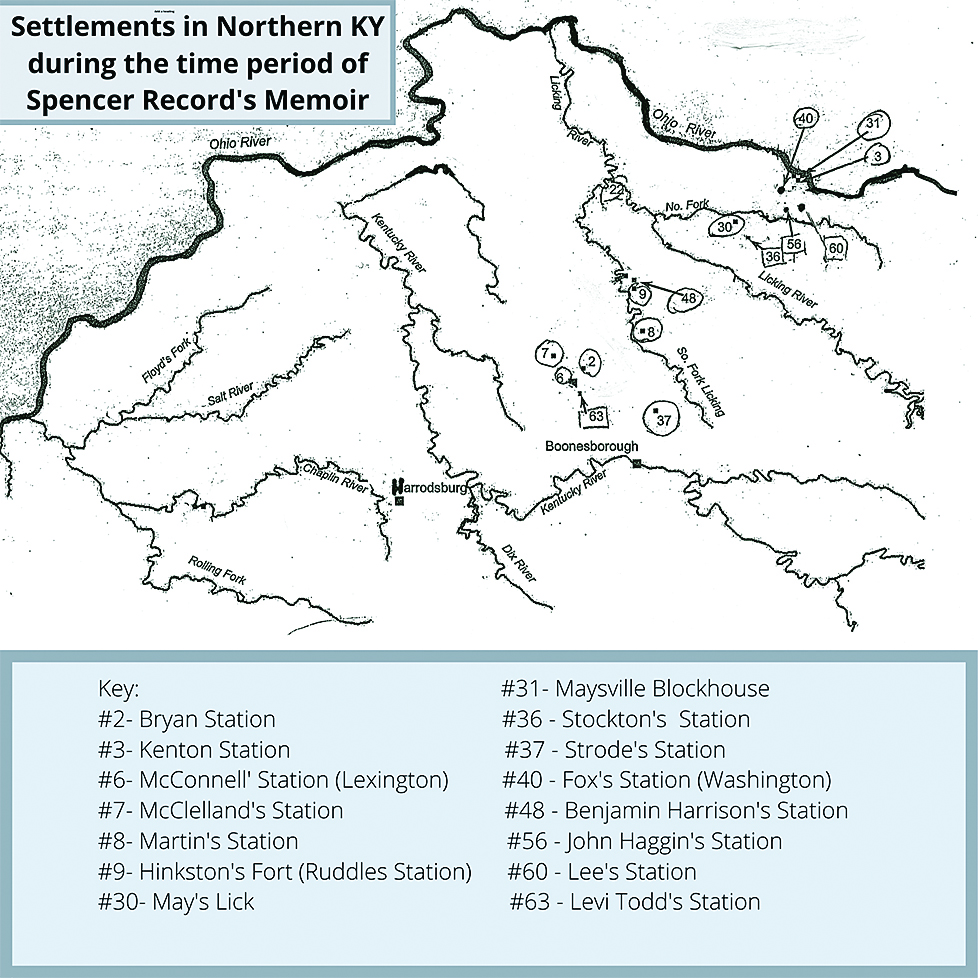
In 1793, Spencer received a Captain’s commission from the state of Kentucky. He had previously served in this capacity for the state of Virginia, losing his commission when Kentucky became a state. From this point up to the Treaty of Greenville, Indian raids were increasing. Spencer, along with men from other stations, made trips into Ohio to reclaim stolen goods, kidnapped settlers, and to run Indians out of the territory. After Anthony Wayne defeated the Indians at Fallen Timbers in August of 1794, peace with the Indians was attained and lasted until 1811. In the course, of this responsibility, Spencer Records, traveled to many stations in central and northeastern Kentucky, including John Kenton’s Station, Simon Kenton’s Station, McConnell’s Station, Levi Todd’s Station and more. (See map.)
In March of 1801, Spencer Records and his family relocated to Ross County, Ohio, where he built and operated a saw and grist mill. He continued in his career as a surveyor. The Records family left Ohio for Bartholomew County, Indiana in 1821. He lived in Indiana at the time of his death which is not known but believed to be around 1849/50. His last memoir note was that he and his wife had been married “going on sixty years” and that he was 87 years old.
The Records family lived in a time when history was being made nearly every day. The United States was a new and fledgling country. There was land to explore. They endured much hardship but yet thrived in their environment. The possibilities were endless.