
By Nila Harris
While most people you know are readying themselves for Christmas, there is another group of people who celebrate a different holiday in December—the Jewish holiday of Hanukkah. Hanukkah or The Festival of Lights is a Jewish holiday, typically celebrated in late November and early December. It commemorates the Maccabean victories over King Antiochus IV Epiphanes who was the Seleucid king of the Hellenistic Syrian kingdom from 175-164 BCE. The Maccabees were the first Jews to fight to defend their religious beliefs. The group was led by Matthias and his son Judas Maccabeus. After a three-year battle and subsequent victory against King Antiochus, Judas ordered a cleansing and restoration of the Temple. He also proclaimed that the dedication of the Temple would be celebrated for eight days every year.
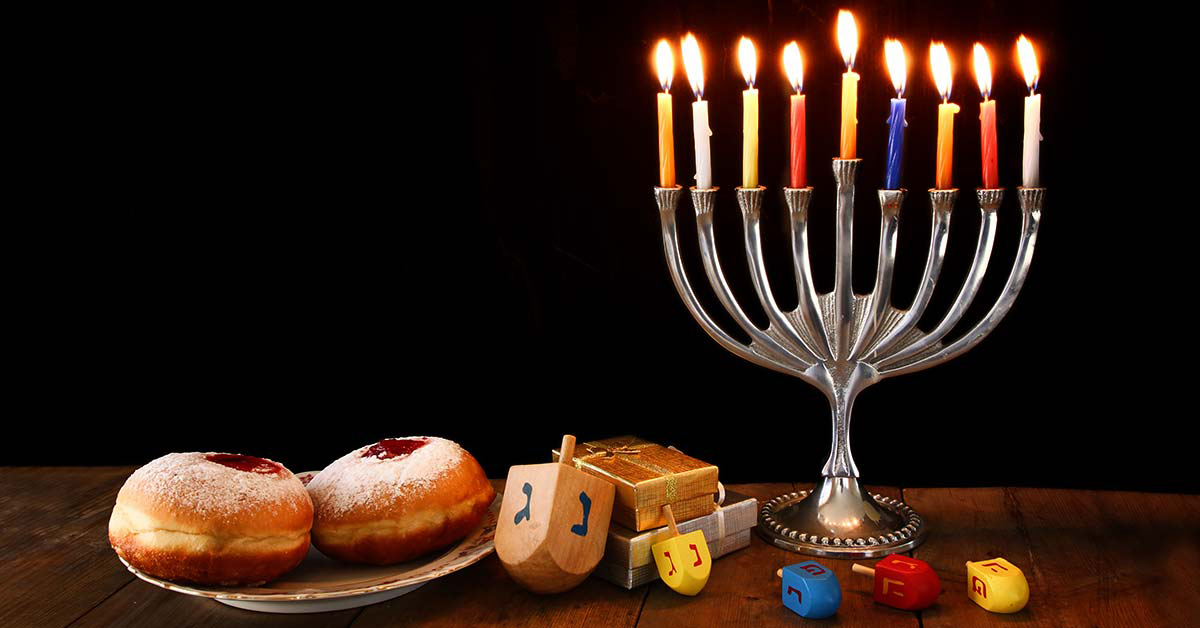
One of the best-known traditions of Hanukkah is the lighting of a menorah. A menorah is a candelabra with eight branches plus a shammash candle which is used to light the other eight candles. One candle is lit each evening until eight candles are lit on the eighth evening. This practice is a part of the Talmud writings which describe the miracle of the oil. “According to the Talmud, when Judas Maccabeus entered the Temple, he found only a small jar of oil that had not been defiled by Antiochus. The jar contained only enough oil for one day, but miraculously the oil burned for eight days until new consecrated oil could be found, establishing the precedent that the festival should last for eight days.” brittanica.com
Starting sometime in the late 19th century, the practice of gift-giving began during Hanukkah. The traditional gift is gelt, which is Yiddish for money, in the form of chocolate covered coins. These coins can be used for the popular Hanukkah game—spinning the dreidel. Other Hanukkah gifts often include: night one—some sort of big gift; night two—socks; night three—treats; night four—pajamas; night five—a toy; night six—a book; night seven—gelt; night eight—a family gift.
Hanukkah involves other Jewish traditions such as the daily reading of Scriptures, reciting Psalms, singing songs, and public readings of the Torah (the first five books of the Hebrew Bible). The eating of latkes (fried potato pancakes) and sufganiyot (jelly doughnuts) is a common occurrence. Families play a gambling game with a spinning top called a dreidel. Jewish children are often told that spinning the dreidel started when the reading of the Torah was outlawed during the Seleucid persecution of the Jews. Many variations of this story have been passed down over the years. The dreidel has four sides with the words “nun, gimmel, hey, shin”, which stands for “nes gadol haya sham”—a great miracle happened here, referring to the miracle of the oil. Regardless of the origin, the game is played for the same reasons the other Hanukkah traditions happen—to celebrate freedom from persecution.
Hanukkah begins the evening of December 7th and continues through December 15th this year. It is always on the 25th day of Kislev on the Hebrew calendar. Kislev is a month in November-December and is sometimes referred to as “the month of dreams”.
This author is hopeful for an end to the devastation that has occurred against the Jewish population in Israel and the United States, and that joyous Hanukkah celebrations can be held worldwide
It’s Hanukkah!