

By Carolyn Reid
Pendleton County’s 109 Board met to hear community questions concerning Rumpke’s proposed expansion last Monday night, March 14. The hearing lasted just under 40 minutes, and much of that time was spent going over protocols and procedures.
Approximately 30 people, including Judge/Executive David Fields, Billy Steele, Solid Waste Coordinator, the members of the 109 Board, the four magistrates, fiscal court candidate Anthony Strong, and representatives of Rumpke, along with community members, attended the hearing.
Fields oversaw the hearing, explaining the legal responsibilities of the proceedings, while Deborah DeLong and Shannon Powers of the Department for Environmental Protection moderated, taking the names of those who wished to speak who wished to submit questions in writing, or who wished to have information about the questions that were presented.
The hearing consisted of questions only. Audience members could raise their concerns, but the 109 Board could not answer anything at that time. They were given 15 days to research and to give answers in writing to those in attendance and who submitted the necessary information to receive answers to those questions.
Anyone who did not wish to speak but who wished to submit questions and concerns in writing had two days after the hearing to do so.
Speakers had three minutes to speak, and if time allowed at the end, they could return to speak once others had time to do so.
Jenny Beetz of Rose Hill Winery on State Route 17 just off U.S. 27, was the first to be given a chance to speak.
Beetz expressed concerns not only for the amount of traffic moving along the road in a day, but also for the number of new places being built, bringing in new families along the stretch. The number of vehicles passing per day combined with the number of homes in the area prompted her to ask if the state could get involved in improving the road conditions. She also cited the dangerous intersection of U.S. 27 and SR 17 and the sharp turns on it. She mentioned the speeds of all the trucks running on that road as well as the number of trucks. She stated that she counted 27 trucks going by her house in 15 minutes the day of the hearing.
Her second concern centered on the smells from the Bryan Griffin Road area. She stated that she cannot open the farm to the public because of the odors that she said were coming from Rumpke.
Once Beetz was able to return to the podium, she asked if the county was being compensated appropriately considering the county is taking in garbage from CVG, Scott County, and other areas, and she admitted she did not really know what was fair, under the circumstances.
Darrin Gregg, Magistrate of District 3, spoke next. He agreed with Beetz regarding the traffic concerns, but he argued that he had worked in the Rumpke landfill and had been in the middle of it, and the odors were not coming from that landfill but rather were coming from another business in that area.
He brought up the positives of the landfill, such as the employment numbers and the amount of tax dollars the langfill brings in. He argued, too, that garbage has to be dealt with, and the landfill is here.
“I would like to see the road made safer,” he said.
Rick Mineer, Magistrate of District 4, expressed his concerns with the expansion. “What are we doing to our kids and grand-kids? We are the dumping ground of Northern and Central Kentucky.”
For these reasons, he said he was reluctant to make the site bigger.
As far as traffic safety was concerned, he asked how Atomic (the semi) drivers were paid--by the load or by the hour.
But his main concern came back to the children and the future and how large the site will get.
Gregg returned to speak, explaining that the covers on the garbage trucks are closed as they travel to keep the garbage in the truck. He also cited personal experience. “As far as safety is concerned, Rumpke is one of the safest companies in the state.”
After Gregg’s comments, the public hearing was closed with the understanding that responses would be returned in writing on March 29. Those responses will be published in The Falmouth Outlook.
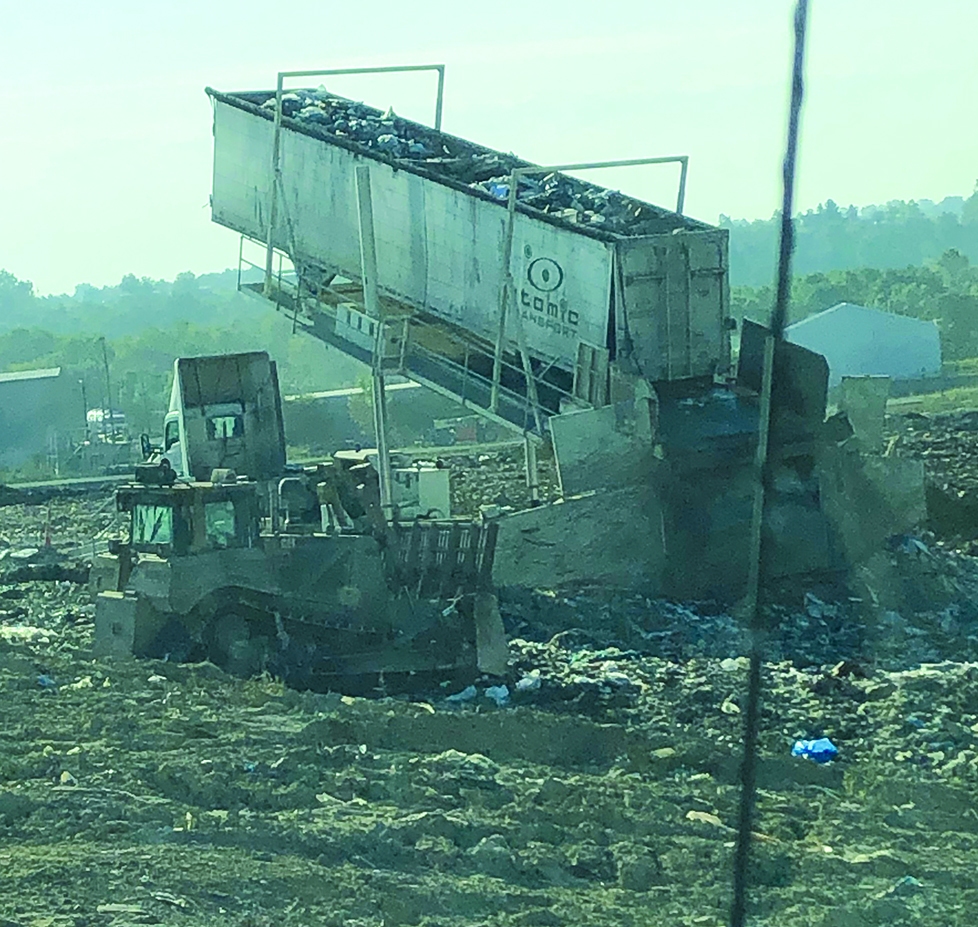
The tipper, shown here, unloads waste in the Butler Rumpke landfill. These semis travel Pendleton County roads nearly every day of the week, and their presence along with the presence of other trucks were was laid out as a concern during the course of the hearing. Trucks like the one pictured above were called into question during the hearing not only for the amount of travel they do along the roads in a day, but also for the tonnage of the individual vehicles that are loaded with garbage from other areas s